- Topics
A new-year’s message from the Director General, NAOJ
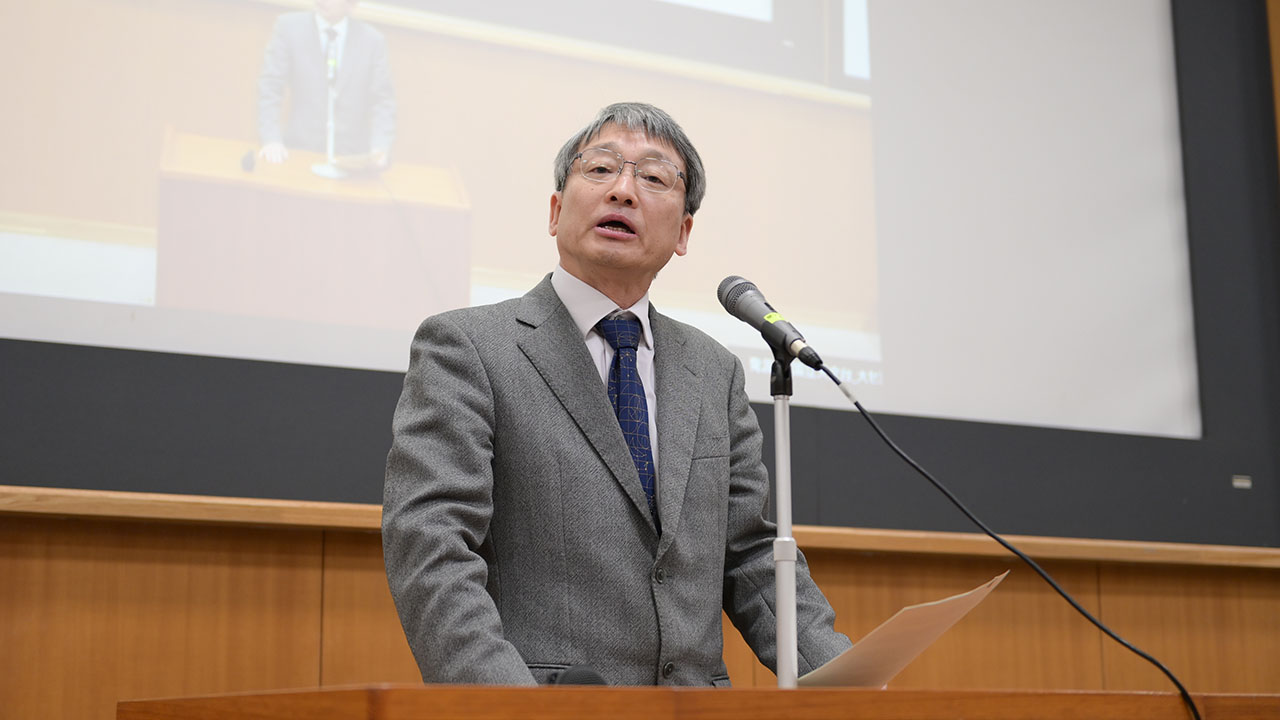
Everyone, happy new year of the Horse. I would like to say a few words to mark the start of 2026.
It has been close to 2 years since I assumed the position as Director General of NAOJ. I have a new appreciation for how important NAOJ is as the central institute for astronomy in Japan, and the high hopes placed upon it. In particular, as an inter-university research institute, it shoulders the indispensable role of advancing astronomy through the construction and operation of large-scale telescopes and computers, which would be difficult for individual universities.
In 2025, planning for the NAOJ Science Roadmap for the next mid-term plan period, starting from 2027, made great strides thanks to the efforts of researchers in the community and the NAOJ staff; and lively discussions were held at the NAOJ Future Planning Symposium in December. We have a clear vision of NAOJ’s future direction, and intend to start work on the Implementation Plan.
The Subaru Telescope, which started operation in 1999, continues to churn out observational results. Especially noteworthy, after a construction period extending over 15 year, the ultra-wide field-of-view multi-object spectrograph ʻŌnohiʻula PFS started science operations from March of last year. The next generation facility observational instrument ULTIMATE-Subaru is also being developed in tandem with the wide-field adaptive optics system. Preparation for unmanned night-operation of the telescope and aging countermeasures are also advancing.
ALMA set a new record for the most observation time in a cycle. The steady flow of results from open-use continues, with the announcements of results from research led by young researchers coming one after another. Also, development has started for the Wideband Sensitivity Upgrade aiming to greatly increase observational efficiency through wider bandwidth and better sensitivity.
The TMT project had a difficult year, with the proposed reductions of the United States budget for science and technology announced last May. But with the strong backing of the community, we are actively working towards construction while communicating closely with the government of Japan.
Also, the VERA Project centered around Mizusawa VLBI Observatory is expanding to a wider observational network and collaborative research with the VLBI of various Asian countries in addition to the VLBI network JVN with Japanese universities.
Nobeyama Radio Observatory has welcomed many visitors since becoming a Mecca for fans of the “Case Closed” anime. Together with the ASTE telescope operating in the harsh environment of Atacama Chile, the 45-meter telescope is conducting not only observations but also tests for new observational instruments.
In solar observations, in addition to the continuation of the HINODE satellite and ground-based observations, full-scale production has started in collaboration with JAXA’s Institute of Space and Astronautical Science for the next solar observation satellite, SOLAR-C. The JASMINE Project is also conducting various activities working through the study phase.
The Advanced Technology Center continues to make indispensable contributions to the development and operation of the observational instruments and other equipment needed for these observatories. The Space Innovation Center was established last September to apply cutting-edge astronomy technology to space industries and support startup ventures.
There is much excitement lately about the importance of Big Data and AI activities. The Astronomy Data Center conducts the archiving and public release of observational data, including data captured at domestic universities, and the number of publications using that data is approaching 100 per year.
The Public Relations Center continues to actively engage in outreach and education activities. In Ishigaki Island, the annual Southern Island Star Festival was held on a grand scale. Also last year, the “Pokémon Astronomical Observatory” exhibit in collaboration with the perennially popular “Pokémon” opened at Sagamihara City Museum in November. In addition, a splendid commemorative lecture was held in December leading up to the 100th anniversary since the launch of the Chronological Scientific Tables compiled by NAOJ.
The Division of Science, charged with connecting theory and observations, has made large contributions, especially to the analysis of world trends in the field of astronomy for the Science Roadmap, and the number of publications continues to grow annually, now exceeding 250.
The production of results based on open use of the computing resources in CfCA continues to go well. CfCA is becoming an active center for young simulation astronomy researchers, and the number of publications exceeds 150 annually.
KAGRA, being developed together with the University of Tokyo and other institutes, has recovered after having been knocked offline by the Noto Peninsula Earthquake, and the sensitivity has been greatly improved.
Other cooperative and collaborative activities with universities include OISTER; open use of the SEIMEI Telescope implemented skillfully by the Subaru Telescope Okayama Branch; and the 188-cm telescope dome shutter repair, which was the largest renovation in 65 years, successfully completed in cooperation with Science Tokyo and Asakuchi City and the restart of operation.
In graduate student education, in addition to programs with SOKENDAI and the University of Tokyo, we are planning to strengthen education while considering diversity and collaboration with engineering.
In other activities, through international collaboration we held a symposium jointly with the University of Hawaiʻi, and EAMA11 was successfully held by EACOA in Niigata in December, including participation from south-east Asia and India.
We must not forget that these activities are made possible by the stalwart support of the Administration Department and each office. Budgetarily, based on difficulties due to increases in supplies expenses and personnel expenses and the cheap yen value, conditions are going to continue where we can only offer you minimal activities budgets.
The Japanese supplementary budget continues to offer partial relief for supplies expenses and personnel expenses, and donation activities are increasing. But with the continuing low yen value, it is highly likely that the severe conditions will continue. I ask everyone to make efforts to economize while we work together to secure new revenue sources.
Each of us may not feel like we are making much progress in our daily work, but looking back on this past year, even in the harsh budgetary conditions, NAOJ has been active and continues to develop. Please take pride in your work as a member of the NAOJ staff, and be diligent in your daily tasks.
Thank you for listening to my New Year’s address.
January 6, 2026
Dr. Mamoru Doi