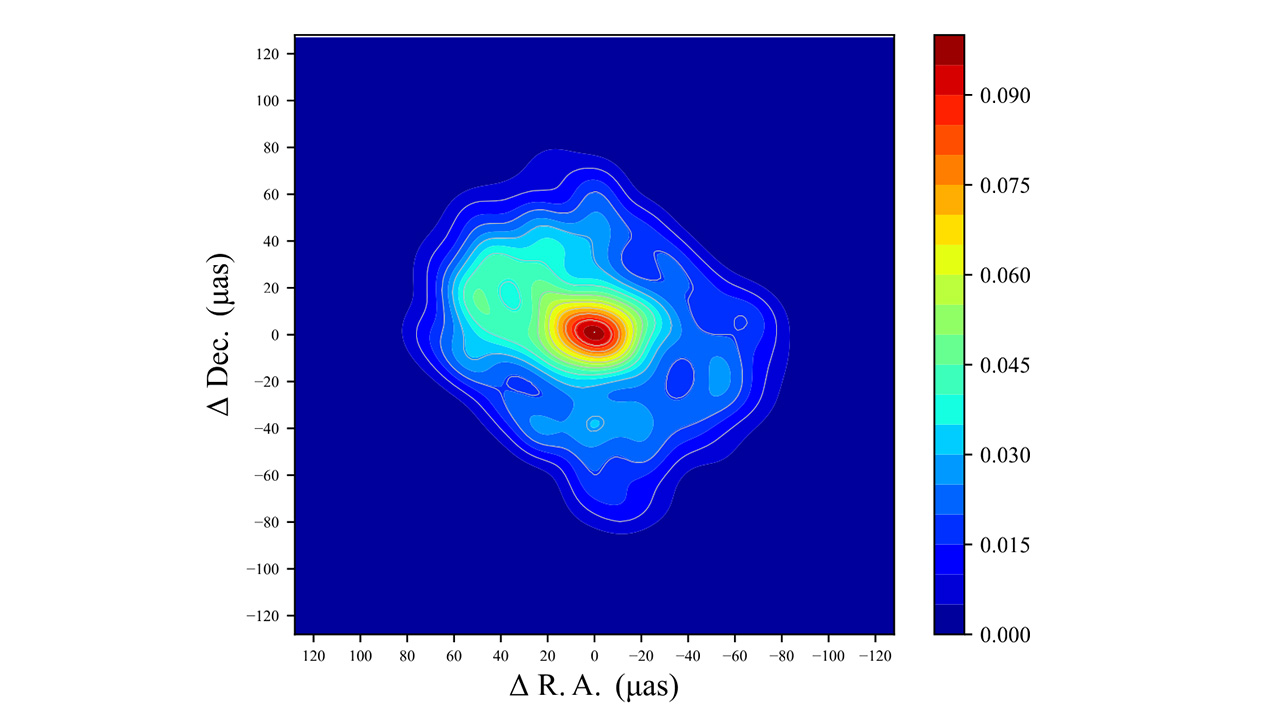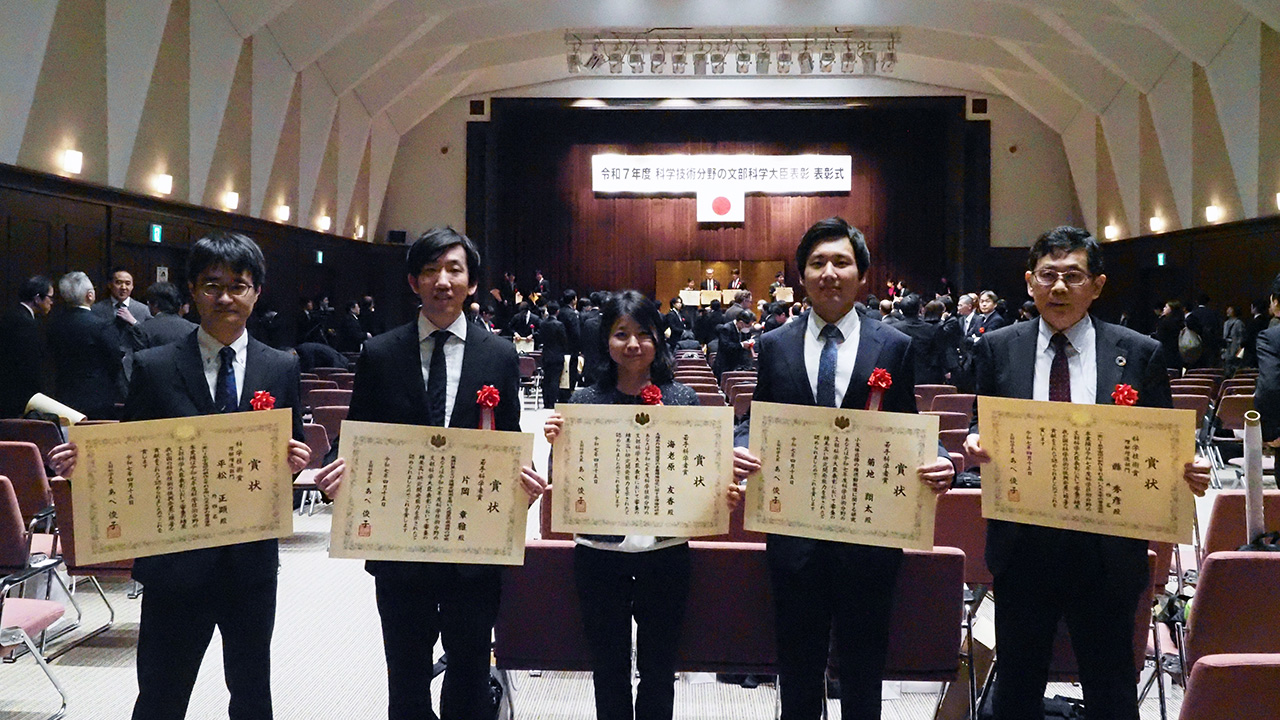
<?xml version="1.0" encoding="UTF-8"?>
<feed xmlns="http://www.w3.org/2005/Atom">
<title>NAOJ - National Astronomical Observatory of Japan</title>
<link rel="alternate" type="text/html" href="https://www.nao.ac.jp/en/" />
<link rel="self" type="application/atom+xml" href="https://www.nao.ac.jp/en/atom.xml" />
<updated>2026-05-14T00:30:51Z</updated>
<subtitle>The National Astronomical Observatory of Japan (NAOJ), the national center of astronomical research in Japan, has the most advanced observing facilities in the world. As an Inter-University Research Institute, we promote the open use of these facilities among researchers throughout Japan, as well as encourage flexible international cooperation. NAOJ aims to promote the development of astronomy, astrophysics, and the related fields of science.</subtitle>


<entry>
  <title>Astronomers Find Most Chemically Primitive Galaxy in Early Universe - News</title>
  <link rel="alternate" type="text/html" href="https://www.nao.ac.jp/en/news/science/2026/20260514-dos.html" />
  <id>tag:www.nao.ac.jp,2026:/en/news//41.13845</id>
  <published>2026-05-14T01:00:00Z</published>
  <updated>2026-05-14T00:30:51Z</updated>
  <summary>An international team of astronomers has used the James Webb Space Telescope (JWST) and a natural phenomenon known as gravitational lensing to achieve a definitive characterization of LAP1-B, an ultra-faint galaxy from 13 billion years ago. Expanding upon initial detections, this new study revealed a record-breaking low oxygen abundance -- merely 1/240th that of the Sun. This chemically primitive state, coupled with an elevated carbon-to-oxygen ratio and a dominant dark matter halo, suggests that LAP1-B is the long-sought “ancestor” of the mysterious fossil galaxies found near our Milky Way Galaxy today.</summary>
  <author>
    <name>National Astronomical Observatory of Japan (NAOJ)</name>
    <uri>https://www.nao.ac.jp/en/</uri>
  </author>
  
    <category term="Science" />
  
  <content type="html" xml:lang="en-us" xml:base="https://www.nao.ac.jp/en/news/">
  
<![CDATA[<figure>
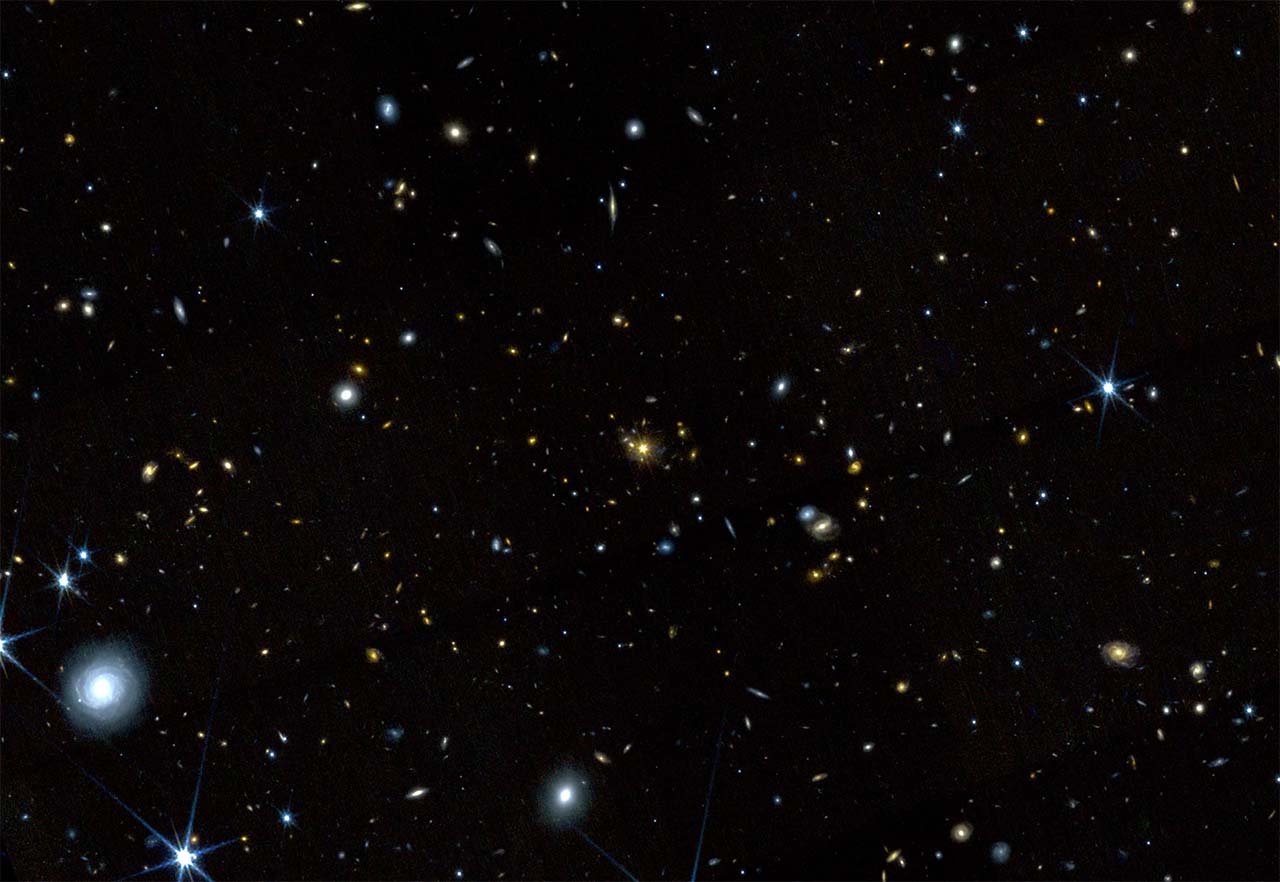
  <img src="/en/contents/news/science/2026/20260514-dos-fig.jpg" alt="Revealing the Nature of the Ultra-Faint Galaxy LAP1-B through a giant "gravitational lens."" />
  
    <figcaption>Revealing the Nature of the Ultra-Faint Galaxy LAP1-B through a giant “gravitational lens.” A 3 color image created from data taken with the Near-Infrared Camera (NIRCam) on the James Webb Space Telescope (JWST). Because the stars in this galaxy are extremely faint and few in number, the galaxy is invisible in the background image taken by NIRCam, but another instrument, the Near-Infrared Spectrograph (NIRSpec) was able to detect chemical signatures. A visualization (not an actual image) of the NIRSpec velocity and distribution data is shown in the inset for oxygen (green) and two different excitation states of hydrogen (blue and red). (Credit: NASA, ESA, CSA & K. Nakajima et al., Nature)</figcaption>
  
</figure>]]>
  
  <![CDATA[<p>An international team of astronomers has used the James Webb Space Telescope (JWST) and a natural phenomenon known as gravitational lensing to achieve a definitive characterization of LAP1-B, an ultra-faint galaxy from 13 billion years ago. Expanding upon initial detections, this new study revealed a record-breaking low oxygen abundance – merely 1/240th that of the Sun. This chemically primitive state, coupled with an elevated carbon-to-oxygen ratio and a dominant dark matter halo, suggests that LAP1-B is the long-sought “ancestor” of the mysterious fossil galaxies found near our Milky Way Galaxy today.</p>

<p>Just after the Big Bang, contained only light elements like hydrogen and helium. The heavier elements, such as oxygen and carbon, were forged much later inside the hearts of the very first stars. For decades, astronomers have tried to find the moment these “first-generation stars” began scattering heavier elements across the cosmos. However, the earliest galaxies hosting such young, primordial stars are so small and faint that seeing their chemical makeup was considered nearly impossible – until now.</p>

<p>A research team led by Kimihiko Nakajima of Kanazawa University and including Masami Ouchi at the National Astronomical Observatory of Japan (NAOJ) and the University of Tokyo focused on a tiny, ultra-faint galaxy named LAP1-B. Its light was magnified 100 times by a phenomenon called “gravitational lensing,” where the gravity of a massive galaxy cluster acts like a natural giant telescope lens in space. By staring at this spot for over 30 hours with JWST, the team determined that the galaxy’s oxygen abundance is roughly 1/240th that of the Sun.
“I was instantly thrilled by the extreme lack of oxygen,” says Nakajima. “Finding a galaxy in such a primitive state is astonishing. It’s a chemical signature that clearly indicates a primordial galaxy caught in the moments shortly after its formation.”</p>

<p>Beyond its primitive nature, the galaxy exhibited a high carbon-to-oxygen abundance ratio. This unique ratio of elements aligns closely with theoretical predictions for the material dispersed by the explosions of the universe’s first-generation stars.</p>

<p>The team also discovered that LAP1-B is incredibly lightweight – less than 3,300 times the mass of the Sun – implying that most of the galaxy consists of invisible dark matter. This feature, together with its unique chemical makeup, makes it a near-perfect match for the “Ultra-Faint Dwarf galaxies (UFDs)” found near our Milky Way Galaxy today, which are extremely dim, small, and contain very few stars.</p>

<p>“UFDs are not only the faintest galaxies; they are composed of ancient stars over 12 billion years old and are often described as ‘fossils of the Universe,’” explains Ouchi. “Astronomers suspected they might be the remains of the Universe’s earliest galaxies because they lack heavy elements, but astronomers never had a direct link – until we found LAP1-B.”</p>

<p>Ouchi continues: “It is a profound surprise to find that LAP1-B looks exactly like the ‘ancestor’ we had only imagined in theories. This helps us solve the mystery of why these cosmic fossils have survived in their current form to the present day.”</p>

<p>This discovery establishes a new way to map the birth of elements and the formation of the Universe’s oldest structures. Moving forward, the team will use JWST to search for even more primitive objects, aiming to find the very first galaxies ever formed.</p>
]]>
  </content>
</entry>

<entry>
  <title>Outer Solar System Object Has an Atmosphere But Shouldn’t - News</title>
  <link rel="alternate" type="text/html" href="https://www.nao.ac.jp/en/news/science/2026/20260505-prc.html" />
  <id>tag:www.nao.ac.jp,2026:/en/news//41.13842</id>
  <published>2026-05-04T15:00:00Z</published>
  <updated>2026-05-11T07:55:11Z</updated>
  <summary>A team of professional and amateur Japanese astronomers found evidence for a thin atmosphere around a small body in the outer Solar System. The object is so small that it should not have a sustainable atmosphere, raising questions about when and how the atmosphere formed. Future observations to better characterize the atmosphere will help solve these mysteries.</summary>
  <author>
    <name>National Astronomical Observatory of Japan (NAOJ)</name>
    <uri>https://www.nao.ac.jp/en/</uri>
  </author>
  
    <category term="Science" />
  
  <content type="html" xml:lang="en-us" xml:base="https://www.nao.ac.jp/en/news/">
  
<![CDATA[<figure>
  <img src="/en/contents/news/science/2026/20260505-prc-fig.jpg" alt="Artist’s conception of this research showing an imagined time sequence as a star passes behind a TNO with an atmosphere." />
  
    <figcaption>Artist’s conception of this research showing an imagined time sequence as a star passes behind a TNO with an atmosphere. (Credit: NAOJ)</figcaption>
  
</figure>]]>
  
  <![CDATA[<p>A team of professional and amateur Japanese astronomers found evidence for a thin atmosphere around a small body in the outer Solar System. The object is so small that it should not have a sustainable atmosphere, raising questions about when and how the atmosphere formed. Future observations to better characterize the atmosphere will help solve these mysteries.</p>

<p>In the cold reaches of the outer Solar System lie thousands of small objects known as trans-Neptunian objects (TNOs) because they lie outside the orbit of Neptune. A thin atmosphere has been observed around Pluto, the most famous TNO, but studies of other TNOs have yielded negative results. Most TNOs are so cold, and their surface gravity so weak, that they are not expected to retain atmospheres.</p>

<p>But astronomers like to expect the unexpected, so they took advantage of a lucky “natural experiment” to look for an atmosphere around a TNO known as (612533) 2002 XV<sub>93</sub>. This object, abbreviated as 2002 XV<sub>93</sub>, has a diameter of approximately 500 km. For reference, Pluto’s diameter is 2,377 km. The orbit of 2002 XV<sub>93</sub> is such that, as seen from Japan, it passed directly in front of a star on January 10, 2024. As the star disappears behind 2002 XV<sub>93</sub>, it might gradually fade, indicating that the light is being attenuated as it passes through a thin atmosphere; or it might suddenly wink out as it slips behind the solid surface of the TNO.</p>

<p>A team of professional and amateur astronomers, led by Ko Arimatsu at NAOJ Ishigakijima Astronomical Observatory, observed the star as 2002 XV<sub>93</sub> passed in front of it from multiple sites in Japan. The obtained data are consistent with attenuation by an atmosphere.</p>

<p>Calculations show that the atmosphere found around 2002 XV<sub>93</sub> is expected to last less than 1000 years unless it is replenished. So it must have been created or replenished recently. Observations by the James Webb Space Telescope show no signs of frozen gases on the surface of 2002 XV<sub>93</sub> that might sublimate to form an atmosphere. One possibility is that some event brought frozen or liquid gases from deep inside the TNO to the surface. Another possibility is that a comet crashed into 2002 XV<sub>93</sub>, releasing gas that formed a temporary atmosphere. Further observations are needed to distinguish between these two scenarios.</p>

<figure class="c-ratio16-9">
  <iframe width="1280" height="720" src="https://www.youtube.com/embed/pHgoRPLFopI" title="YouTube video player" frameborder="0" allow="accelerometer; autoplay; clipboard-write; encrypted-media; gyroscope; picture-in-picture; web-share" referrerpolicy="strict-origin-when-cross-origin" allowfullscreen></iframe>
  <figcaption class="c-figcaption l-container-sm">Conceptual video showing how the light from a star changes when it passes behind an object with an atmosphere. (Credit: NAOJ)</figcaption>
</figure>
]]>
  </content>
</entry>

<entry>
  <title>Subaru Telescope Captures Comet 3I/ATLAS Composition Change - News</title>
  <link rel="alternate" type="text/html" href="https://www.nao.ac.jp/en/news/science/2026/20260415-subaru.html" />
  <id>tag:www.nao.ac.jp,2026:/en/news//41.13836</id>
  <published>2026-04-15T01:00:00Z</published>
  <updated>2026-04-16T07:11:50Z</updated>
  <summary>The Subaru Telescope observed the interstellar comet 3I/ATLAS on January 7, 2026 (UT), after it made its closest approach to the Sun. By observing colors in the coma around the comet, astronomers could estimate the ratio of carbon dioxide to water. This ratio is much lower than that inferred from earlier observations by space telescopes. These findings suggest that the chemistry of the coma is evolving over time and offers clues to the structure of comet 3I/ATLAS.</summary>
  <author>
    <name>National Astronomical Observatory of Japan (NAOJ)</name>
    <uri>https://www.nao.ac.jp/en/</uri>
  </author>
  
    <category term="Science" />
  
  <content type="html" xml:lang="en-us" xml:base="https://www.nao.ac.jp/en/news/">
  
<![CDATA[<figure>
  <img src="/en/contents/news/science/2026/20260415-subaru-fig.jpg" alt="Interstellar comet 3I/ATLAS (C/2025 N1) captured by the Subaru Telescope on December 13, 2025 (Hawaii-Aleutian Standard Time)." />
  
    <figcaption>Interstellar comet 3I/ATLAS (C/2025 N1) captured by the Subaru Telescope on December 13, 2025 (Hawaii-Aleutian Standard Time). This image was created by combining three different wavelengths: V-band (550 nanometers, depicted in blue), R-band (660 nanometers, depicted in green), and I-band (805 nanometers, depicted in red). (Credit: NAOJ)</figcaption>
  
</figure>]]>
  
  <![CDATA[<p>The Subaru Telescope observed the interstellar comet 3I/ATLAS on January 7, 2026 (UT), after it made its closest approach to the Sun. By observing colors in the coma around the comet, astronomers could estimate the ratio of carbon dioxide to water. This ratio is much lower than that inferred from earlier observations by space telescopes. These findings suggest that the chemistry of the coma is evolving over time and offers clues to the structure of comet 3I/ATLAS.</p>

<p>Comet 3I/ATLAS (C/2025 N1) has garnered much attention as a comet which originated outside of the Solar System. A research group led by Yoshiharu Shinnaka of the Koyama Space Science Institute, Kyoto Sangyo University, used the Subaru Telescope to observe comet 3I/ATLAS after perihelion, the comet’s closest approach to the Sun. The team applied analytical methods and expertise accumulated through investigations of Solar System comets to the data.</p>

<p>From this analysis, the team was able to estimate the ratio of carbon dioxide (CO<sub>2</sub>) to water (H<sub>2</sub>O) in the coma, the cloud of gas around the nucleus of the comet. Because the gas in the coma comes from the nucleus, the coma composition provides hints to the composition of the nucleus.
Thanks to its notoriety, 3I/ATLAS had already been observed by space telescopes prior to perihelion. The CO<sub>2</sub>/H<sub>2</sub>O ratio calculated from the Subaru Telescope data was lower than the ratio suggested by the space telescope data. This change is consistent with the idea that the composition of the nucleus interior differs from that of the exterior, and as 3I/ATLAS heated up during its pass by the Sun, gas started to escape from different parts of the nucleus.</p>

<p>Shinnaka comments, “With the full-scale operation of survey telescopes in the coming years, many more interstellar objects are expected to be discovered. By applying the observational and analytical techniques we have developed through studies of Solar System comets to interstellar objects, we can now directly compare comets hailing from both inside and outside the Solar System and explore differences in their composition and evolution. Through studies of such objects, we hope to gain a deeper understanding of how planetesimals and planets formed in a wide variety of stellar systems, including our own Solar System.”</p>]]>
  </content>
</entry>

<entry>
  <title>How Jupiter Cultivated More Large Moons than Saturn — A magnetospheric cavity explains the difference - News</title>
  <link rel="alternate" type="text/html" href="https://www.nao.ac.jp/en/news/science/2026/20260408-cfca.html" />
  <id>tag:www.nao.ac.jp,2026:/en/news//41.13833</id>
  <published>2026-04-08T05:00:00Z</published>
  <updated>2026-04-15T02:07:23Z</updated>
  <summary>The Solar System’s two largest gas giant planets, Jupiter and Saturn, have extensive but very different families of moons orbiting them. New simulations conducted on the PC cluster at the Center for Computational Astrophysics (CfCA), National Astronomical Observatory of Japan (NAOJ) showed that the planet’s magnetic field plays a role in creating an environment where the new moons can survive and grow, thus shaping the evolution of the system.</summary>
  <author>
    <name>National Astronomical Observatory of Japan (NAOJ)</name>
    <uri>https://www.nao.ac.jp/en/</uri>
  </author>
  
    <category term="Science" />
  
  <content type="html" xml:lang="en-us" xml:base="https://www.nao.ac.jp/en/news/">
  
<![CDATA[<figure>
  <img src="/en/contents/news/science/2026/20260408-cfca-fig.jpg" alt="Artist’s impression of the simulations conducted in this research." />
  
    <figcaption>Artist’s impression of the simulations conducted in this research. Jupiter (lower left) has a strong magnetic field which creates a cavity in its circumplanetary disk. Saturn (upper right) lacks a strong magnetic field so its circumplanetary disk evolves without a cavity. (Credit: Yuri I. Fujii/L-INSIGHT [Kyoto University], Shinichiro Kinoshita)</figcaption>
  
</figure>]]>
  
  <![CDATA[<p>The Solar System’s two largest gas giant planets, Jupiter and Saturn, have extensive but very different families of moons orbiting them. New simulations conducted on the PC cluster at the Center for Computational Astrophysics (CfCA), National Astronomical Observatory of Japan (NAOJ) showed that the planet’s magnetic field plays a role in creating an environment where the new moons can survive and grow, thus shaping the evolution of the system.</p>

<p>Jupiter has more than 100 reported moons, including four large ones (Ganymede, Callisto, Io, and Europa). Saturn has more than 280 reported moons, but only one large one (Titan). So it is a puzzle why Saturn managed to cultivate more moons, but fewer large moons than Jupiter.</p>

<p>A team led by Kyoto University, including researchers from institutes in Japan and China, used the PC cluster at CfCA, NAOJ, to simulate the formation of the moon systems around Jupiter and Saturn. This simulation recreated the planets’ internal structure to calculate the thermal evolution of Jupiter and Saturn and how their magnetic fields have varied over time.</p>

<p>Moons form from material in a “circumplanetary disk” of gas and dust orbiting the young planet. The disk nurtures the young moons, but interactions with the disk may cause them to fall into the planet. The simulations showed that young Jupiter generated a strong planetary magnetic field that created a safe “cavity” around the planet where its young large moons were prevented from migrating too close to their host planet. Young Saturn lacked a strong magnetic field, so only one large moon managed to survive.</p>

<p>“Testing planet formation theory is somewhat difficult because we have only our Solar System for reference, but there are multiple satellite systems close to us whose detailed characteristics we can observe,” says Yuri I. Fujii, primary author of the report announcing these findings. Next, the team is interested in expanding their theory to other moons and potential exomoon systems.</p>]]>
  </content>
</entry>

<entry>
  <title>We are Not Alone: Our Sun Escaped From Galactic Center Together with Stellar “Twins” - News</title>
  <link rel="alternate" type="text/html" href="https://www.nao.ac.jp/en/news/science/2026/20260313-jasmine.html" />
  <id>tag:www.nao.ac.jp,2026:/en/news//41.13826</id>
  <published>2026-03-13T05:00:00Z</published>
  <updated>2026-04-20T07:12:22Z</updated>
  <summary>Researchers have uncovered evidence that our Sun was part of a mass migration of similar “twins” leaving the core regions of our Galaxy, 4 to 6 billion years ago. The team created and studied an unprecedentedly accurate catalogue of stars and their properties using data from the European Space Agency’s Gaia satellite. This discovery sheds light on the evolution of our Galaxy, particularly the development of the rotating bar-like structure at its center.</summary>
  <author>
    <name>National Astronomical Observatory of Japan (NAOJ)</name>
    <uri>https://www.nao.ac.jp/en/</uri>
  </author>
  
    <category term="Science" />
  
  <content type="html" xml:lang="en-us" xml:base="https://www.nao.ac.jp/en/news/">
  
<![CDATA[<figure>
  <img src="/en/contents/news/science/2026/20260313-jasmine-fig.jpg" alt="" />
  
    <figcaption>A mass migration of stellar twins. Stars similar to our Sun form a mass migration from the center of the Milky Way Galaxy, occurring approximately 4 to 6 billion years ago. (Credit: NAOJ) 
<a href="/en/contents/news/science/2026/20260313-jasmine-fig-full.jpg" download target="_blank"> <i class="far fa-download u-mr1"></i>Download Image (578KB)</a> <a href="/en/contents/news/science/2026/20260313-jasmine-movie.mp4" download target="_blank"><i class="far fa-download u-mr1"></i>Download Movie (33MB)</a>
</figcaption>
  
</figure>]]>
  
  <![CDATA[<p>Researchers have uncovered evidence that our Sun was part of a mass migration of similar “twins” leaving the core regions of our Galaxy, 4 to 6 billion years ago. The team created and studied an unprecedentedly accurate catalogue of stars and their properties using data from the European Space Agency’s Gaia satellite. This discovery sheds light on the evolution of our Galaxy, particularly the development of the rotating bar-like structure at its center.</p>

<p>While archaeology on Earth studies the human past, galactic archaeology traces the vast journeys of stars and galaxies. For example, scientists know that our Sun was born around 4.6 billion years ago, more than 10,000 light-years closer to the center of the Milky Way than we are today. While studies of the composition of stars support this theory, this has long proven a conundrum to scientists. Observations reveal an enormous bar-like structure at our galactic center which creates a “corotation barrier,” which makes it difficult for stars to escape so far from the center. </p>

<p>So how did we get here? To answer this question, a team led by Assistant Professors Daisuke Taniguchi from Tokyo Metropolitan University and Takuji Tsujimoto from the National Astronomical Observatory of Japan undertook an unprecedentedly large study of solar “twins,” stars which have very similar temperature, surface gravity, and composition to our Sun. They used data taken by the European Space Agency’s Gaia satellite mission, a daunting trove of observations covering two billion stars and other objects. They created a catalogue of 6,594 stellar “twins,” a collection around 30 times larger than previous surveys.</p>

<p>From this immense list, they were able to obtain the most accurate picture to date of the ages of these stars, carefully correcting for the selection bias of stars which are easier to see. Looking at the distribution of ages, they noticed a broad peak for stars around 4 to 6 billion years old: this includes our Sun, and is evidence for similar stars of similar age, positioned around the same distance from the center of the Galaxy. This means that our Sun is not at its current position by accident, but as part of a much larger stellar migration.</p>

<p>This discovery sheds light not only on the nature of our Solar System, but also the evolution of the Galaxy itself. The corotation barrier created by the bar structure at the galactic center would not allow for such a mass egress. However, the story changes if the bar was still being formed at the time. The ages of our stellar “twins” reveal not only when the mass escape occurred, but also the time range over which the bar was formed.</p>

<p>The center of the Galaxy is a far less hospitable environment for the evolution of life than the outer regions. The team’s findings thus illuminate a key factor in how our Solar System, and in turn our planet, found itself in a region of the Galaxy where organisms could develop and evolve.</p>

<p>In the future the team hopes to use precise observations of the stars similar in age to the Sun to look for stars born near the same time and place as the Sun to determine the point of origin and travel route of the mass migration. It is expected that the Japanese JASMINE astrometry satellite mission being developed by the National Astronomical Observatory of Japan will contribute to this research.</p>
]]>
  </content>
</entry>

<entry>
  <title>Theory-Breaking Extremely Fast-Growing Black Hole - News</title>
  <link rel="alternate" type="text/html" href="https://www.nao.ac.jp/en/news/science/2026/20260122-subaru.html" />
  <id>tag:www.nao.ac.jp,2026:/en/news//41.13823</id>
  <published>2026-01-22T01:00:00Z</published>
  <updated>2026-03-11T07:58:24Z</updated>
  <summary>An international research team has discovered a supermassive black hole growing rapidly while radiating bright X-rays and radio waves. This combination of features contradicts the current models of black hole growth, requiring astronomers to look for a new explanation.</summary>
  <author>
    <name>National Astronomical Observatory of Japan (NAOJ)</name>
    <uri>https://www.nao.ac.jp/en/</uri>
  </author>
  
    <category term="Science" />
  
  <content type="html" xml:lang="en-us" xml:base="https://www.nao.ac.jp/en/news/">
  
<![CDATA[<figure>
  <img src="/en/contents/news/science/2026/20260122-subaru-fig.jpg" alt="Artist’s impression of a supermassive black hole system." />
  
    <figcaption>Artist’s impression of a supermassive black hole system. Infalling gas forms a bright corona near the black hole. In some systems, a jet is launched. (Credit: NASA/JPL-Caltech)</figcaption>
  
</figure>]]>
  
  <![CDATA[<p>An international research team has discovered a supermassive black hole growing rapidly while radiating bright X-rays and radio waves. This combination of features contradicts the current models of black hole growth, requiring astronomers to look for a new explanation.</p>

<p>Supermassive black holes, millions to billions of times the mass of the Sun, sit in the centers of most galaxies. They grow by pulling in surrounding gas. As gas spirals inward, it can power a compact region of hot plasma known as a corona which emits X-rays. Some supermassive black holes also form a jet of outflowing material that emits strongly at radio wavelengths.</p>

<p>But if gas falls towards a supermassive black hole too quickly, radiation from the gas starts to push back on the material flowing behind it, causing the flow to slow down. This sets a self-regulating “Eddington Limit,” a speed limit on how fast gas can flow in. Like most speed limits, the Eddington Limit is broken sometimes, enabling rapid mass build-up over short cosmic timescales.</p>

<p>To test whether such extreme growth occurs in the early Universe, a team led by scientists at Waseda University and Tohoku University used the Subaru Telescope to measure the motion of gas around a supermassive black hole that existed when the Universe was less than 1.5 billion years old and found that it is accreting gas at 13 times the Eddington Limit. More surprisingly, the object also emits bright X-rays and radio waves. In the current models, super-Eddington accretion should change the gas flow and suppress X-ray and radio wave production. This unexpected combination hints at physical mechanisms not yet fully captured by current models of extreme accretion.</p>

<p>The team thinks the object is in a short-lived transitional stage. A sudden burst of inflowing gas may have pushed the system into a super-Eddington state, while a bright X-ray corona and a strong radio-wave emitting jet remained simultaneously energized for a limited time before the system settles toward a more typical regime.</p>

<p>This discovery offers a rare glimpse of time-variable black hole growth in the early Universe—an important step toward understanding the rapid growth of massive black holes.</p>
]]>
  </content>
</entry>

<entry>
  <title>Cotton Candy Worlds Evolve into Rock Candy Worlds - News</title>
  <link rel="alternate" type="text/html" href="https://www.nao.ac.jp/en/news/science/2026/20260108-abc.html" />
  <id>tag:www.nao.ac.jp,2026:/en/news//41.13822</id>
  <published>2026-01-08T01:00:00Z</published>
  <updated>2026-03-03T06:43:49Z</updated>
  <summary>Using data spanning a decade taken by telescopes around the world and in space, including NAOJ’s 188-cm telescope in Okayama, astronomers have been able to weigh a quartet of baby planets. Even though the planets are currently large and puffy, like cotton candy, as they mature they will evolve into smaller, denser rocky worlds like Earth or small gaseous ‘sub-Neptune’ worlds.</summary>
  <author>
    <name>National Astronomical Observatory of Japan (NAOJ)</name>
    <uri>https://www.nao.ac.jp/en/</uri>
  </author>
  
    <category term="Science" />
  
  <content type="html" xml:lang="en-us" xml:base="https://www.nao.ac.jp/en/news/">
  
<![CDATA[<figure>
  <img src="/en/contents/news/science/2026/20260108-abc-fig.jpg" alt="Artist’s conception of the four planets around a young star observed in this research." />
  
    <figcaption>Artist’s conception of the four planets around a young star observed in this research. The puffy planets may be losing their atmospheres due to the intense radiation from the star. (Credit: Astrobiology Center)</figcaption>
  
</figure>]]>
  
  <![CDATA[<p>Using data spanning a decade taken by telescopes around the world and in space, including NAOJ’s 188-cm telescope in Okayama, astronomers have been able to weigh a quartet of baby planets. Even though the planets are currently large and puffy, like cotton candy, as they mature they will evolve into smaller, denser rocky worlds like Earth or small gaseous ‘sub-Neptune’ worlds.</p>

<p>One of the biggest recent surprises in astronomy is the discovery that most stars like the Sun harbor a planet between the size of Earth and Neptune at a distance from the star closer than Mercury’s orbit around the Sun. These ‘super-Earths’ and ‘sub-Neptunes’ are the most common type of planets known in the Galaxy. However, their formation has been shrouded in mystery. Now, an international team of astronomers has found a crucial missing link in the formation process. By weighing four newborn planets in the V1298 Tau system, the team captured a rare snapshot of the development of compact, multi-planet systems.</p>

<p>The study focused on V1298 Tau, a star located 352 light-years away in the direction of the constellation Taurus. V1298 Tau is only about 20 million years old, compared to our 4.5-billion-year-old Sun. Around this young, active star, four giant planets, all between the sizes of Neptune and Jupiter, have been observed in a fleeting and turbulent phase of rapid evolution. This system appears to be a progenitor of the type of compact, multi-planet systems found throughout the Galaxy.</p>

<p>The team used data taken over a decade by an arsenal of ground- and space-based telescopes to precisely measure when each planet passed in front of the star, an event known as a transit. By timing these transits, astronomers detected small variations in the planets' orbits. Their orbital configuration and gravity cause them to tug on each other, slightly speeding up or slowing down the timing of the transit. These tiny shifts in timing allowed the team to robustly measure the planets' masses for the first time. The planets, despite being 5 to 10 times the radius of Earth, were found to have masses of only 5 to 15 times that of our own world. This makes them incredibly low-density—more like planetary-sized cotton candy than Earth-like rock candy worlds.</p>

<p>This puffiness helps solve a long-standing puzzle in planet formation. A planet that simply forms and cools down over time would be much more compact. The puffiness indicates that these planets have already undergone a dramatic transformation, rapidly losing much of their original atmospheres and cooling. Now the planets are predicted to continue evolving, losing their atmospheres and shrinking significantly, transforming into the kinds of super-Earths and sub-Neptunes which are often observed.</p>

<p>The V1298 Tau system now serves as a crucial laboratory for understanding the origins of the most abundant planetary systems in the Milky Way, giving scientists an unprecedented glimpse into the turbulent and transformative lives of young worlds. Understanding systems like V1298 Tau may also help explain why our own Solar System lacks the super-Earths and sub-Neptunes that are so abundant elsewhere in the Galaxy.</p>
]]>
  </content>
</entry>

<entry>
  <title>A new-year’s message from the Director General, NAOJ - News</title>
  <link rel="alternate" type="text/html" href="https://www.nao.ac.jp/en/news/topics/2026/20260106-new-years-message.html" />
  <id>tag:www.nao.ac.jp,2026:/en/news//41.13821</id>
  <published>2026-01-06T02:00:00Z</published>
  <updated>2026-03-03T06:27:56Z</updated>
  <summary>Everyone, happy new year of the Horse. I would like to say a few words to mark the start of 2026.</summary>
  <author>
    <name>National Astronomical Observatory of Japan (NAOJ)</name>
    <uri>https://www.nao.ac.jp/en/</uri>
  </author>
  
    <category term="Topics" />
  
  <content type="html" xml:lang="en-us" xml:base="https://www.nao.ac.jp/en/news/">
  
<![CDATA[<figure>
  <img src="/en/contents/news/topics/2026/20260106-new-years-message-fig.jpg" alt="" />
  
</figure>]]>
  
  <![CDATA[<p>Everyone, happy new year of the Horse. I would like to say a few words to mark the start of 2026.</p>

<p>It has been close to 2 years since I assumed the position as Director General of NAOJ. I have a new appreciation for how important NAOJ is as the central institute for astronomy in Japan, and the high hopes placed upon it. In particular, as an inter-university research institute, it shoulders the indispensable role of advancing astronomy through the construction and operation of large-scale telescopes and computers, which would be difficult for individual universities.</p>

<p>In 2025, planning for the NAOJ Science Roadmap for the next mid-term plan period, starting from 2027, made great strides thanks to the efforts of researchers in the community and the NAOJ staff; and lively discussions were held at the NAOJ Future Planning Symposium in December. We have a clear vision of NAOJ’s future direction, and intend to start work on the Implementation Plan.</p>

<p>The Subaru Telescope, which started operation in 1999, continues to churn out observational results. Especially noteworthy, after a construction period extending over 15 year, the ultra-wide field-of-view multi-object spectrograph ʻŌnohiʻula PFS started science operations from March of last year. The next generation facility observational instrument ULTIMATE-Subaru is also being developed in tandem with the wide-field adaptive optics system. Preparation for unmanned night-operation of the telescope and aging countermeasures are also advancing.</p>

<p>ALMA set a new record for the most observation time in a cycle. The steady flow of results from open-use continues, with the announcements of results from research led by young researchers coming one after another. Also, development has started for the Wideband Sensitivity Upgrade aiming to greatly increase observational efficiency through wider bandwidth and better sensitivity.</p>

<p>The TMT project had a difficult year, with the proposed reductions of the United States budget for science and technology announced last May. But with the strong backing of the community, we are actively working towards construction while communicating closely with the government of Japan.</p>

<p>Also, the VERA Project centered around Mizusawa VLBI Observatory is expanding to a wider observational network and collaborative research with the VLBI of various Asian countries in addition to the VLBI network JVN with Japanese universities.</p>

<p>Nobeyama Radio Observatory has welcomed many visitors since becoming a Mecca for fans of the “Case Closed” anime. Together with the ASTE telescope operating in the harsh environment of Atacama Chile, the 45-meter telescope is conducting not only observations but also tests for new observational instruments.</p>

<p>In solar observations, in addition to the continuation of the HINODE satellite and ground-based observations, full-scale production has started in collaboration with JAXA’s Institute of Space and Astronautical Science for the next solar observation satellite, SOLAR-C. The JASMINE Project is also conducting various activities working through the study phase.</p>

<p>The Advanced Technology Center continues to make indispensable contributions to the development and operation of the observational instruments and other equipment needed for these observatories. The Space Innovation Center was established last September to apply cutting-edge astronomy technology to space industries and support startup ventures.</p>

<p>There is much excitement lately about the importance of Big Data and AI activities. The Astronomy Data Center conducts the archiving and public release of observational data, including data captured at domestic universities, and the number of publications using that data is approaching 100 per year.</p>

<p>The Public Relations Center continues to actively engage in outreach and education activities. In Ishigaki Island, the annual Southern Island Star Festival was held on a grand scale. Also last year, the “Pokémon Astronomical Observatory” exhibit in collaboration with the perennially popular “Pokémon” opened at Sagamihara City Museum in November. In addition, a splendid commemorative lecture was held in December leading up to the 100th anniversary since the launch of the Chronological Scientific Tables compiled by NAOJ.</p>

<p>The Division of Science, charged with connecting theory and observations, has made large contributions, especially to the analysis of world trends in the field of astronomy for the Science Roadmap, and the number of publications continues to grow annually, now exceeding 250.</p>

<p>The production of results based on open use of the computing resources in CfCA continues to go well. CfCA is becoming an active center for young simulation astronomy researchers, and the number of publications exceeds 150 annually.</p>

<p>KAGRA, being developed together with the University of Tokyo and other institutes, has recovered after having been knocked offline by the Noto Peninsula Earthquake, and the sensitivity has been greatly improved.</p>

<p>Other cooperative and collaborative activities with universities include OISTER; open use of the SEIMEI Telescope implemented skillfully by the Subaru Telescope Okayama Branch; and the 188-cm telescope dome shutter repair, which was the largest renovation in 65 years, successfully completed in cooperation with Science Tokyo and Asakuchi City and the restart of operation.</p>

<p>In graduate student education, in addition to programs with SOKENDAI and the University of Tokyo, we are planning to strengthen education while considering diversity and collaboration with engineering.</p>

<p>In other activities, through international collaboration we held a symposium jointly with the University of Hawaiʻi, and EAMA11 was successfully held by EACOA in Niigata in December, including participation from south-east Asia and India.</p>

<p>We must not forget that these activities are made possible by the stalwart support of the Administration Department and each office. Budgetarily, based on difficulties due to increases in supplies expenses and personnel expenses and the cheap yen value, conditions are going to continue where we can only offer you minimal activities budgets.</p>

<p>The Japanese supplementary budget continues to offer partial relief for supplies expenses and personnel expenses, and donation activities are increasing. But with the continuing low yen value, it is highly likely that the severe conditions will continue. I ask everyone to make efforts to economize while we work together to secure new revenue sources.</p>

<p>Each of us may not feel like we are making much progress in our daily work, but looking back on this past year, even in the harsh budgetary conditions, NAOJ has been active and continues to develop. Please take pride in your work as a member of the NAOJ staff, and be diligent in your daily tasks.</p>

<p>Thank you for listening to my New Year’s address.</p>

<p class="u-text-right">January 6, 2026<br>
Dr. Mamoru Doi</p>
]]>
  </content>
</entry>

<entry>
  <title>First Discoveries from New Subaru Telescope Program - News</title>
  <link rel="alternate" type="text/html" href="https://www.nao.ac.jp/en/news/science/2025/20251204-subaru.html" />
  <id>tag:www.nao.ac.jp,2025:/en/news//41.13757</id>
  <published>2025-12-04T01:00:00Z</published>
  <updated>2025-12-19T01:53:27Z</updated>
  <summary>Astronomers using the Subaru Telescope in Hawaiʻi have discovered a massive planet and a brown dwarf orbiting distant stars. The discoveries are the first results from OASIS (Observing Accelerators with SCExAO Imaging Survey), which combines space-based measurements with the Subaru Telescope’s advanced imaging to find hidden worlds. These discoveries in turn enable NASA’s upcoming Roman Space Telescope to test critical technologies for imaging Earth-like planets. </summary>
  <author>
    <name>National Astronomical Observatory of Japan (NAOJ)</name>
    <uri>https://www.nao.ac.jp/en/</uri>
  </author>
  
    <category term="Science" />
  
  <content type="html" xml:lang="en-us" xml:base="https://www.nao.ac.jp/en/news/">
  
<![CDATA[<figure>
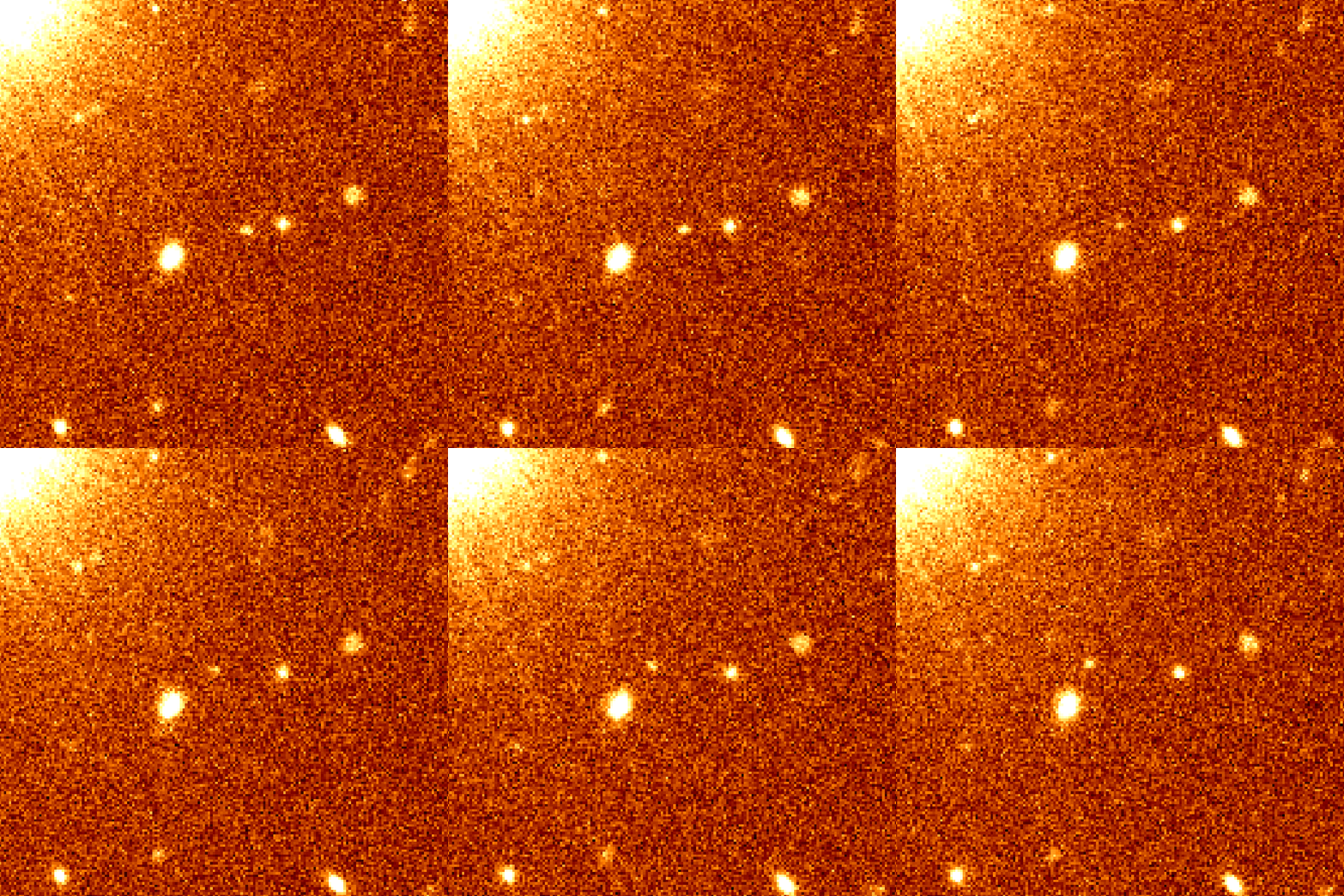
  <img src="/en/contents/news/science/2025/20251204-subaru-fig.jpg" alt="Time-lapse movie of the Subaru Telescope images which led to the discovery of HIP 54515 b (indicated by the arrow)." />
  
    <figcaption>Time-lapse movie of the Subaru Telescope images which led to the discovery of HIP 54515 b (indicated by the arrow). The planet’s host star has been blocked in this image. The star’s position is indicated by the star mark. The dotted line shows the outline of the mask used to block the star. (Credit: T. Currie/Subaru Telescope, UTSA)</figcaption>
  
</figure>]]>
  
  <![CDATA[<p>Astronomers using the Subaru Telescope in Hawaiʻi have discovered a massive planet and a brown dwarf orbiting distant stars. The discoveries are the first results from OASIS (Observing Accelerators with SCExAO Imaging Survey), which combines space-based measurements with the Subaru Telescope’s advanced imaging to find hidden worlds. These discoveries in turn enable NASA’s upcoming Roman Space Telescope to test critical technologies for imaging Earth-like planets.</p>

<p>Only about 1% of stars host massive planets and brown dwarfs that can be photographed directly with current telescopes. Even in young planetary systems where these objects are still glowing hot with the energy of having just been formed, making them brighter and easier to detect, they’re still much fainter than their host stars and are easily lost in the stellar glare. The key question for astronomers has been: where to look for these objects?</p>

<p>That is where OASIS [Principal Investigator (PI): Thayne Currie / Deputy-PI: Masayuki Kuzuhara] comes in. The program uses measurements from two European Space Agency missions—Hipparcos and Gaia—to identify stars being tugged by the gravity of unseen companions. OASIS then targets these promising candidates with the Subaru Coronagraphic Extreme Adaptive Optics (SCExAO) system, which provides the exceptional precision and advanced technology needed to actually photograph these hidden companions.</p>

<p>The newly discovered planet, HIP 54515 b, orbits a star 271 light-years away in the constellation Leo. With nearly 18 times Jupiter’s mass, it circles its star at about Neptune’s distance from our Sun. But the star and planet appear very close when seen from Earth; roughly the size that a baseball seen 100 km away would appear. The SCExAO system produced extremely sharp images allowing us to see the planet.</p>

<p>The second discovery, HIP 71618 B, is a 60 Jupiter mass brown dwarf located 169 light-years away in the constellation Bootes. Brown dwarfs are sometimes called “failed stars”—because they form like stars but never become massive enough to sustain nuclear fusion.</p>

<p>What makes HIP 71618 B special is its highly suitable properties for observations with NASA’s Roman Space Telescope. Roman will carry out a technology demonstration to test coronagraph systems that future telescopes will need to photograph Earth-like planets around other stars—planets that are ten billion times fainter than their host stars. Before this discovery, astronomers didn’t have a single confirmed target meeting all the strict requirements for this demonstration. HIP 71618 B changes that, checking off the boxes for being a suitable target: its star is bright and the brown dwarf is in the right location. At the Roman Coronagraph’s operating wavelengths it will be faint enough compared to its star to validate these new technologies.</p>

<p>These discoveries from OASIS showcase how combining space-based precision star-tracking and ground-based direct imaging can reveal planets and brown dwarfs that would otherwise remain hidden. This type of tag-team observations leading to new discoveries shows that the Subaru Telescope will continue to be a world-leading observatory in astronomy even as new telescopes come online.</p>
]]>
  </content>
</entry>

<entry>
  <title>NAOJ and KASI Sign ALMA Collaboration MoU Amendment - News</title>
  <link rel="alternate" type="text/html" href="https://www.nao.ac.jp/en/news/topics/2025/20251110-alma.html" />
  <id>tag:www.nao.ac.jp,2025:/en/news//41.13756</id>
  <published>2025-11-10T03:00:00Z</published>
  <updated>2025-12-26T08:17:36Z</updated>
  <summary>The National Astronomical Observatory of Japan (NAOJ) and the Korea Astronomy and Space Science Institute (KASI) have signed an amendment to their Memorandum of Understanding (MoU) originally concluded in 2014, aiming to enhance the security and depth of their cutting-edge research collaboration.</summary>
  <author>
    <name>National Astronomical Observatory of Japan (NAOJ)</name>
    <uri>https://www.nao.ac.jp/en/</uri>
  </author>
  
    <category term="Topics" />
  
  <content type="html" xml:lang="en-us" xml:base="https://www.nao.ac.jp/en/news/">
  
<![CDATA[<figure>
  <img src="/en/contents/news/topics/2025/20251110-alma-fig.jpg" alt="" />
  
    <figcaption>NAOJ Director General Mamoru Doi (left) and KASI President Jang-Hyun Park (right). (Credit: KASI)</figcaption>
  
</figure>]]>
  
  <![CDATA[<p>The National Astronomical Observatory of Japan (NAOJ) and the Korea Astronomy and Space Science Institute (KASI) have signed an amendment to their Memorandum of Understanding (MoU) originally concluded in 2014, aiming to enhance the security and depth of their cutting-edge research collaboration.</p>

<p>On October 23, 2025, NAOJ Director General Mamoru Doi, NAOJ ALMA Project Director Satoru Iguchi, and NAOJ Acting ALMA Program Manager George Kosugi visited KASI for the signing ceremony. The amendment reflects the need to reinforce secure collaboration in light of global trends, ensuring that sensitive data and intellectual property are protected. Beyond the formal signing, the visit featured in-depth discussions with KASI’s leadership and researchers. The meeting provided an opportunity to review past achievements from the research collaboration and share the progress of the Total Power GPU Spectrometer (TPGS), which is currently being co-developed under this agreement and represents one of East Asia’s major contributions to ALMA2’s Wideband Sensitivity Upgrade (WSU). They also actively explored new opportunities for collaboration that will be essential in the ALMA2 era.</p>

<figure class="u-mt10">
<img src="/en/contents/news/topics/2025/20251110-alma-fig2.jpg" alt="" class="c-ratio16-9 c-ratio-bg-black">
<figcaption class="c-figcaption">
From left to right: Head of the SKA and ALMA Center in KASI Bong-Won Sohn, Director of Observational Infrastructure Research Se-Jin Oh, NAOJ Acting ALMA Project Manager George Kosugi, NAOJ ALMA Project Director Satoru Iguchi, NAOJ Director General Mamoru Doi, KASI President Jang-Hyun Park, Vice President Young-Jun Choi, Principal Investigator of the Korean ALMA project Jongsoo Kim, and Director of Future Strategy Research Kyoung-Suk Lee. (Credit: KASI)
</figcaption>
</figure>]]>
  </content>
</entry>

<entry>
  <title>Hawai`i County Mayor’s Delegation Visits NAOJ - News</title>
  <link rel="alternate" type="text/html" href="https://www.nao.ac.jp/en/news/topics/2025/20251106-hawaii.html" />
  <id>tag:www.nao.ac.jp,2025:/en/news//41.13755</id>
  <published>2025-11-06T04:00:00Z</published>
  <updated>2025-12-11T06:09:06Z</updated>
  <summary>On October 9, 2025, Hawai`i County Mayor Dr. Kimo Alameda and Deputy Managing Director of the Office of the Mayor Mr. Merrick Nishimoto visited NAOJ Mitaka Campus.</summary>
  <author>
    <name>National Astronomical Observatory of Japan (NAOJ)</name>
    <uri>https://www.nao.ac.jp/en/</uri>
  </author>
  
    <category term="Topics" />
  
  <content type="html" xml:lang="en-us" xml:base="https://www.nao.ac.jp/en/news/">
  
<![CDATA[<figure>
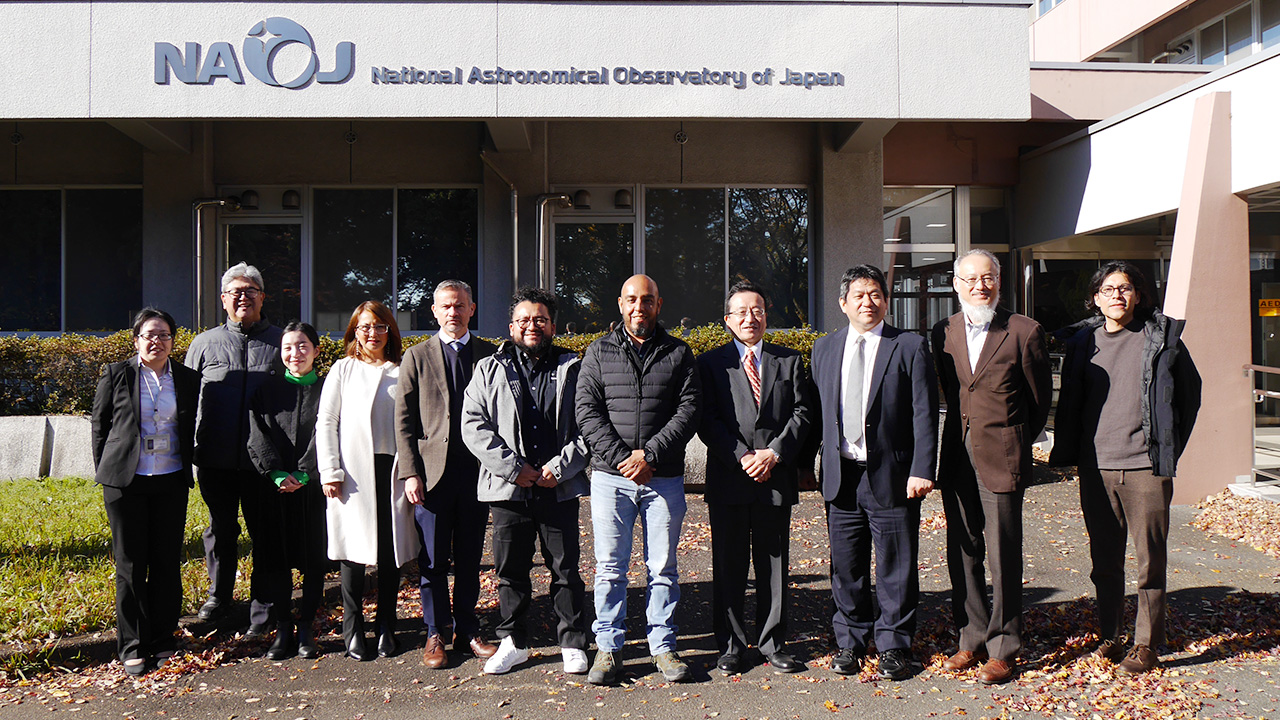
  <img src="/en/contents/news/topics/2025/20251106-hawaii-fig.jpg" alt="The Hawai`i County Mayor’s Delegation and their hosts at NAOJ. Mayor Alameda, fourth from left, and Mr. Nishimoto, fifth from left." />
  
    <figcaption>The Hawai`i County Mayor’s Delegation and their hosts at NAOJ. Mayor Alameda, fourth from left, and Mr. Nishimoto, fifth from left. (Credit: NAOJ)</figcaption>
  
</figure>]]>
  
  <![CDATA[<p>On October 9, 2025, Hawai`i County Mayor Dr. Kimo Alameda and Deputy Managing Director of the Office of the Mayor Mr. Merrick Nishimoto visited NAOJ Mitaka Campus. During the visit, Mayor Alameda held a talk-story session with the staff of NAOJ and relevant institutes, focusing on how Japanese scientists, engineers, and others can best work with the people of Hawai`i for the benefit of people, culture, and the environment, as well as astronomy.</p>

<p>Additionally, Mayor Alameda and Mr. Nishimoto toured various facilities on campus with NAOJ Director General Mamoru Doi. At the 4D2U Dome Theater, they experienced the beautiful four-dimensional view of the Universe created by supercomputer simulations based on recent observational data, including data from the Subaru Telescope on Maunakea. At the Advanced Technology Center, they inspected the ultra-precision machine tool workshop for the fabrication of devices such as ALMA receivers and instrument components for the Subaru Telescope.</p>

<p>NAOJ deeply appreciates the Mayor’s guidance on how to fulfill its shared responsibility in the stewardship of Maunakea. NAOJ remains firmly committed to working hand in hand with the local community to pursue world-leading scientific discoveries together.</p>


<figure class="u-mt10">
<img src="/en/contents/news/topics/2025/20251106-hawaii-fig2.jpg" alt="Receiving an explanation of ALMA receiver parts fabricated with the 3D printer in the Advanced Technology Center." class="c-ratio16-9 c-ratio-bg-black">
<figcaption class="c-figcaption">Receiving an explanation of ALMA receiver parts fabricated with the 3D printer in the Advanced Technology Center. (Credit: NAOJ)
</figcaption>
</figure>


<figure class="u-mt10">
<img src="/en/contents/news/topics/2025/20251106-hawaii-fig3.jpg" alt="Discussion with NAOJ Staff."  class="c-ratio16-9 c-ratio-bg-black">
<figcaption class="c-figcaption">Discussion with NAOJ Staff. (Credit: NAOJ)</figcaption>
</figure>]]>
  </content>
</entry>

<entry>
  <title>Professor Mareki Honma Wins Nishina Memorial Prize - News</title>
  <link rel="alternate" type="text/html" href="https://www.nao.ac.jp/en/news/topics/2025/20251105-award.html" />
  <id>tag:www.nao.ac.jp,2025:/en/news//41.13754</id>
  <published>2025-11-05T08:00:00Z</published>
  <updated>2025-12-11T05:31:50Z</updated>
  <summary>Professor Mareki Honma, Director of NAOJ Mizusawa VLBI Observatory has been awarded the 2025 (the 71st) Nishina Memorial Prize.</summary>
  <author>
    <name>National Astronomical Observatory of Japan (NAOJ)</name>
    <uri>https://www.nao.ac.jp/en/</uri>
  </author>
  
    <category term="Topics" />
  
  <content type="html" xml:lang="en-us" xml:base="https://www.nao.ac.jp/en/news/">
  
<![CDATA[<figure>
  <img src="/en/contents/news/topics/2025/20251105-award-fig.jpg" alt="Left: Professor Mareki Honma. Right: Image of the black hole at the center of M87 captured by the EHT." />
  
    <figcaption>Left: Professor Mareki Honma. (Credit: NAOJ) Right: Image of the black hole at the center of M87 captured by the EHT. (Credit: EHT Collaboration)</figcaption>
  
</figure>]]>
  
  <![CDATA[<p>Professor Mareki Honma, Director of NAOJ Mizusawa VLBI Observatory has been awarded the 2025 (the 71st) Nishina Memorial Prize.</p>

<p>The award recognizes his research achievements in “Contributions to imaging the shadow of supermassive black holes with very long baseline interferometry.” Professor Honma played a central role in observing the “event horizon” of black holes. He was instrumental in establishing a Japanese observational research group early on and led the Event Horizon Telescope (EHT) project in collaboration with researchers around the world. He also spearheaded the development of an optical transmission system to integrate the ALMA telescope array into the EHT, contributing significantly to the success of the observations. Furthermore, he led the Japanese team in achieving major results by introducing a novel data analysis method using sparse modeling to visualize black hole shadows.</p>

<p>Professor Honma comments, “I am deeply honored and delighted to receive the 2025 Nishina Memorial Prize. This achievement is not something I accomplished alone, but rather it is thanks to the support of my collaborators and the staff involved in the EHT project and related organizations such as NAOJ. I sincerely thank all those involved. Encouraged by this recognition, I intend to further advance my research, and I would be grateful for continued support from everyone.”</p>

<p>The Nishina Memorial Prize commemorates the distinguished service of the late Dr. Yoshio Nishina. It is awarded to researchers for outstanding achievements in Japan related to physics or one of its many diverse applications.</p>
]]>
  </content>
</entry>

<entry>
  <title>Young Star Cooks Surroundings with Different Temperatures - News</title>
  <link rel="alternate" type="text/html" href="https://www.nao.ac.jp/en/news/science/2025/20251028-okayama.html" />
  <id>tag:www.nao.ac.jp,2025:/en/news//41.13753</id>
  <published>2025-10-28T00:30:00Z</published>
  <updated>2025-12-19T02:13:33Z</updated>
  <summary>Astronomers have used simultaneous ground-based and space-based observations to measure the temperature and velocity of gas ejected from a young Sun-like star. The result showed a two-component ejection consisting of a hot fast component followed by a slower cooler component. This result is important for understanding how young stars affect their surrounding environment where planets and life may first be forming, and by extension provides insights into the early days of the Solar System, Earth, and life on Earth.</summary>
  <author>
    <name>National Astronomical Observatory of Japan (NAOJ)</name>
    <uri>https://www.nao.ac.jp/en/</uri>
  </author>
  
    <category term="Science" />
  
  <content type="html" xml:lang="en-us" xml:base="https://www.nao.ac.jp/en/news/">
  
<![CDATA[<figure>
  <img src="/en/contents/news/science/2025/20251028-okayama-fig.jpg" alt="An artist’s impression of a mass ejection event from EK Draconis" />
  
    <figcaption>An artist’s impression of a mass ejection event from EK Draconis. Hot, fast plasma is shown in blue, and cooler, slower gas is shown in red.（Credit: NAOJ）</figcaption>
  
</figure>]]>
  
  <![CDATA[<p>Astronomers have used simultaneous ground-based and space-based observations to measure the temperature and velocity of gas ejected from a young Sun-like star. The result showed a two-component ejection consisting of a hot fast component followed by a slower cooler component. This result is important for understanding how young stars affect their surrounding environment where planets and life may first be forming, and by extension provides insights into the early days of the Solar System, Earth, and life on Earth.</p>

<p>The Sun frequently ejects huge masses of hot ionized gas called plasma, associated with solar flares. These events are known as Coronal Mass Ejections (CMEs). Young Sun-like stars have been observed to emit frequent stellar flares, and some of them are known to be associated with large CMEs, dwarfing any observed from the modern Sun. CMEs on the Sun contain components at different temperatures, ranging from 10,000 Kelvin to 1,000,000 Kelvin, but so far data for CMEs on other stars have been limited to a single temperature component, especially low temperature plasma.</p>

<p>To get a more complete understanding of young stars’ CME events, an international team of researchers led by Kosuke Namekata at Kyoto University arranged for ultraviolet observations by the Hubble Space Telescope, and optical observations by ground-based telescopes in Japan and Korea to simultaneously measure different temperature components of a stellar CME event. Their target was the young Sun-like Star EK Draconis, located 111 light-years away in the direction of the constellation Draco.</p>

<p>The team succeeded in observing different temperature components of a CME event. First, hot plasma of 100,000 Kelvin was ejected at 300 to 550 kilometers per second, followed about ten minutes later by a cooler gas of about 10,000 Kelvin ejected at 70 kilometers per second. This indicates that the hotter components of stellar CMEs possess higher kinetic energies than the cooler ones, and thus can affect exoplanetary atmospheres more severely than previously inferred from measurements limited to cool plasma alone.</p>

<p>Because the young Sun was presumably similar to EK Draconis, this provides insights in to the conditions in the early Solar System, which was likely disturbed by huge and fast CMEs. Theoretical and experimental studies suggest that fast CMEs play a role in initiating biomolecules and greenhouse gases, which are essential for the emergence and maintenance of life on an early planet. Therefore, this discovery has major implications for understanding planetary habitability and the conditions under which life emerged on Earth, and possibly elsewhere.</p>

<p>The team plans to continue their research with new observations using X-rays, radio waves, and next-generation UV space telescopes to better understand the conditions around young stars where planets, and possibly living things, form. In particular, this study highlights the importance of UV astronomy, which will be further explored by JAXA’s upcoming LAPYUTA mission.</p>
]]>
  </content>
</entry>

<entry>
  <title>Motion of Planet-Forming Spirals Captured on Video - News</title>
  <link rel="alternate" type="text/html" href="https://www.nao.ac.jp/en/news/science/2025/20250925-alma.html" />
  <id>tag:www.nao.ac.jp,2025:/en/news//41.13752</id>
  <published>2025-09-25T02:33:07Z</published>
  <updated>2025-12-19T02:14:16Z</updated>
  <summary>The Atacama Large Millimeter/submillimeter Array (ALMA) has captured the motion of spirals of dust around a young star and shown that the winding motion of the spiral pattern is conducive to planet formation. This provides new evidence for planet formation around this young star. The results could have implications for other young stars as well.</summary>
  <author>
    <name>National Astronomical Observatory of Japan (NAOJ)</name>
    <uri>https://www.nao.ac.jp/en/</uri>
  </author>
  
    <category term="Science" />
  
  <content type="html" xml:lang="en-us" xml:base="https://www.nao.ac.jp/en/news/">
  
<![CDATA[<figure>
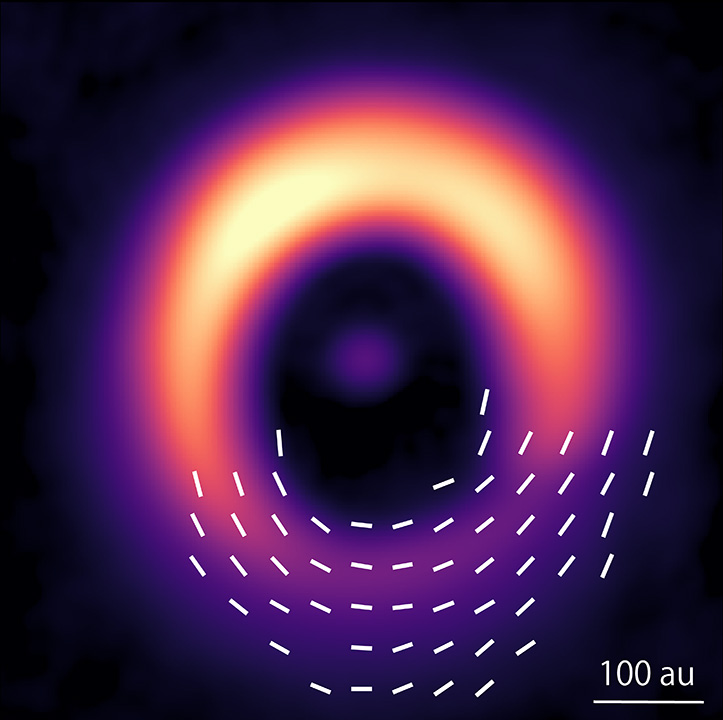
  <img src="/en/contents/news/science/2025/20250925-alma-fig.jpg" alt="ALMA observations of the spiral patterns in the disk around the young star IM Lup" />
  
    <figcaption>ALMA observations of the spiral patterns in the disk around the young star IM Lup. (Credit: ALMA(ESO/NAOJ/NRAO), Tomohiro Yoshida et al.)</figcaption>
  
</figure>]]>
  
  <![CDATA[<p>The Atacama Large Millimeter/submillimeter Array (ALMA) has captured the motion of spirals of dust around a young star and shown that the winding motion of the spiral pattern is conducive to planet formation. This provides new evidence for planet formation around this young star. The results could have implications for other young stars as well.</p>

<p>Observations have revealed a spiral pattern in the disk of gas and dust around the young star IM Lup located 515 light-years away in the direction of the constellation Lupus. Spiral patterns are thought to be one of the signs that a new planet will form soon, but other things, such as an already formed planet, can also form spirals. These different types of spirals cannot be distinguished by visual inspection, but they are expected to move differently over time.</p>

<p>To determine the origin of the spirals around IM Lup, an international research team led by Tomohiro Yoshida, a graduate student at The Graduate University for Advanced Studies, SOKENDAI and the National Astronomical Observatory of Japan (NAOJ), created a stop-motion animation of the spiral pattern using four observations taken by ALMA over the course of seven years. The motion of the spirals in the stop-motion animation shows that they were not caused by an already formed planet, and instead the spirals might be helping to form a new planet.</p>

<p>Tomohiro Yoshida says, “When I saw the outcome of the analysis —the dynamic visualization of the spiral in motion— I screamed with excitement. This achievement was made possible by the long-term, stable operations of the ALMA telescope, which demonstrates the world’s highest performance. In the future, we plan to conduct similar observations on other protoplanetary disks to create a documentary of the entire planetary system formation process.”</p>

<figure class="c-ratio16-9">
<iframe width="1280" height="720" src="https://www.youtube.com/embed/cfDz3kVPoQ0" title="YouTube video player" frameborder="0" allow="accelerometer; autoplay; clipboard-write; encrypted-media; gyroscope; picture-in-picture; web-share" referrerpolicy="strict-origin-when-cross-origin" allowfullscreen></iframe>
                    <figcaption class="c-figcaption">Video of artist’s impression of planet formation around a young star, showing spiral patterns which help the young planets to form. (Credit: ALMA(ESO/NAOJ/NRAO), Tomohiro Yoshida et al.)</figcaption>
</figure>]]>
  </content>
</entry>

<entry>
  <title>Announcing the &quot;Pokémon Astronomical Observatory&quot; Special Exhibition to Explore the Mysteries of the Universe and Pokémon - News</title>
  <link rel="alternate" type="text/html" href="https://www.nao.ac.jp/en/news/topics/2025/20250912-pokemon.html" />
  <id>tag:www.nao.ac.jp,2025:/en/news//41.13751</id>
  <published>2025-09-12T01:00:00Z</published>
  <updated>2026-03-11T07:58:58Z</updated>
  <summary>The National Astronomical Observatory of Japan will collaborate with The Pokémon Company  to hold the “Pokémon Astronomical Observatory,” a special exhibition where visitors can have fun learning about the mysteries of the Universe, that will be hosted by various science museums in Japan. Through this project we aim to spark children’s interest in space, strengthen the talent pool which studies science, and increase overall support for basic science.</summary>
  <author>
    <name>National Astronomical Observatory of Japan (NAOJ)</name>
    <uri>https://www.nao.ac.jp/en/</uri>
  </author>
  
    <category term="Topics" />
  
  <content type="html" xml:lang="en-us" xml:base="https://www.nao.ac.jp/en/news/">
  
<![CDATA[<figure>
  <img src="/en/contents/news/topics/2025/20250912-pokemon-fig.jpg" alt="" />
  
</figure>]]>
  
  <![CDATA[<p>The National Astronomical Observatory of Japan will collaborate with The Pokémon Company (Headquartered in Minato-ku, Tokyo; President and CEO: Tsunekazu Ishihara) to hold the “Pokémon Astronomical Observatory,” a special exhibition where visitors can have fun learning about the mysteries of the Universe, that will be hosted by various science museums in Japan. Through this project we aim to spark children’s interest in space, strengthen the talent pool which studies science, and increase overall support for basic science.</p>

<p>Astronomy is a science which discovers many mysteries in the vast Universe and seeks their answers. The development of astronomy has been driven by the intellectual curiosity of all humans, most notably researchers; the suspense and thrill of new discoveries. The adventures that unfold in the Pokémon game series can be said to be similar to astronomy in many ways, with their suspense and thrill from new discoveries and encounters with the mysterious creatures known as “Pokémon.” </p>

<p>At the “Pokémon Astronomical Observatory” Special Exhibition, everyone, especially children, can enjoy the excitement of exploration and discovery. In the exhibition hall, together with many Pokémon, you can study various visions of the Universe discovered over human history. Please enjoy this unique combination of learning and encounters not available anywhere else.</p>

<p>The “Pokémon Astronomical Observatory” is scheduled to be a traveling exhibition. Starting from the grand opening at Sagamihara City Museum on November 1, 2025, it will be hosted in turn by science museums and other exhibition spaces across Japan. Please refer to the official webpage (Japanese language only) for more details.</p>

<p><small>©Pokémon. ©Nintendo / Creatures Inc. / GAME FREAK inc.
TM, ®, and character names are trademarks of Nintendo.</small></p>
]]>
  </content>
</entry>

<entry>
  <title>Subaru Telescope and the 0.5-meter Solar Optical Telescope aboard “Hinode” have been registered as “Essential Historical Materials for Science and Technology” - News</title>
  <link rel="alternate" type="text/html" href="https://www.nao.ac.jp/en/news/topics/2025/20250910-kahaku.html" />
  <id>tag:www.nao.ac.jp,2025:/en/news//41.13750</id>
  <published>2025-09-10T05:00:00Z</published>
  <updated>2025-12-11T01:55:37Z</updated>
  <summary>The Subaru Telescope and the 0.5-meter Solar Optical Telescope aboard the solar observing satellite &quot;Hinode&quot; operated by the National Astronomical Observatory of Japan have been registered as &quot;Essential Historical Materials for Science and Technology&quot; by the National Museum of Nature and Science in 2025.</summary>
  <author>
    <name>National Astronomical Observatory of Japan (NAOJ)</name>
    <uri>https://www.nao.ac.jp/en/</uri>
  </author>
  
    <category term="Topics" />
  
  <content type="html" xml:lang="en-us" xml:base="https://www.nao.ac.jp/en/news/">
  
<![CDATA[<figure>
  <img src="/en/contents/news/topics/2025/20250910-kahaku-fig.jpg" alt="Subaru Telescope and Solar observing satellite “Hinode”" />
  
    <figcaption>(Left) Subaru Telescope. (Credit: Kazuhito Dobashi/NAOJ) (Right) Solar observing satellite “Hinode.” (Credit: NAOJ/JAXA)</figcaption>
  
</figure>]]>
  
  <![CDATA[<p>The Subaru Telescope and the 0.5-meter Solar Optical Telescope aboard the solar observing satellite “Hinode” operated by the National Astronomical Observatory of Japan have been registered as “Essential Historical Materials for Science and Technology” by the National Museum of Nature and Science in 2025.</p>

<p>The Subaru Telescope is a very large optical-infrared telescope located in the summit area of Maunakea on the island of Hawai‘i. Its primary mirror boasts an aperture of 8.2 meters, making it one of the largest monolithic mirrors in the world. At the end of the 20th century, when the Subaru Telescope was built, Japan, the United States, and Europe were heated rivalry to develop an 8-meter-class telescope. At the time, Japan had little experience building large telescopes of this scale, but by leveraging its radio telescope and satellite communications technologies, Japan succeeded in developing its own telescope. The Subaru Telescope was Japan’s first large-scale optical-infrared telescope established outside of Japan. Since its launch, the Subaru Telescope has repeatedly broken records for discovering the most distant galaxies, and has continued to produce astronomical results that astound people around the world.</p>

<p>The solar observing satellite “Hinode,” launched in 2006, is capable of observing the Sun in three wavelength bands: visible light, extreme ultraviolet, and soft X-rays. The newly registered telescope is the 0.5-meter Solar Optical Telescope aboard “Hinode,” which was developed using 9 of the 17 key technologies adopted in the Subaru Telescope. It used the first optical performance evaluation method in the world to simulate zero-gravity conditions, which has since been adopted in the development of other satellite-mounted optical instruments. Despite its small aperture, it achieved its theoretical best possible resolution of 0.2 arcseconds, producing results in observations of the Sun’s magnetic field structure and solar flares.</p>

<p>The National Museum of Nature and Science maintains a registry of “Essential Historical Materials for Science and Technology” that are “important specimens from the history of science and technology, items that clearly need to be preserved for future generations” and “have had a significant impact on people’s lifestyles, society, culture, and the economy.”</p>
]]>
  </content>
</entry>

<entry>
  <title>Baby Star Sets off Explosion, Gets Caught in Blast - News</title>
  <link rel="alternate" type="text/html" href="https://www.nao.ac.jp/en/news/science/2025/20250805-alma.html" />
  <id>tag:www.nao.ac.jp,2025:/en/news//41.13749</id>
  <published>2025-08-05T01:00:00Z</published>
  <updated>2025-12-19T02:14:53Z</updated>
  <summary>Astronomers have observed an explosion in space that is pushing back against and influencing the baby star which triggered the explosion in the first place. If explosions like this one are common around young stars, then the young stars and their planets are exposed to a harsher environment than previously thought.</summary>
  <author>
    <name>National Astronomical Observatory of Japan (NAOJ)</name>
    <uri>https://www.nao.ac.jp/en/</uri>
  </author>
  
    <category term="Science" />
  
  <content type="html" xml:lang="en-us" xml:base="https://www.nao.ac.jp/en/news/">
  
<![CDATA[<figure>
  <img src="/en/contents/news/science/2025/20250805-alma-fig.jpg" alt="Artist’s impression of a protoplanetary disk distorted by a shock front created by an expanding bubble." />
  
    <figcaption>Artist’s impression of a protoplanetary disk distorted by a shock front created by an expanding bubble. (Credit: ALMA (ESO/NAOJ/NRAO), M. Aizawa et al.)</figcaption>
  
</figure>]]>
  
  <![CDATA[<p>Astronomers have observed an explosion in space that is pushing back against and influencing the baby star which triggered the explosion in the first place. If explosions like this one are common around young stars, then the young stars and their planets are exposed to a harsher environment than previously thought.</p>

<p>Stars and their associated planetary systems are formed from the gravitational collapse of molecular clouds in space. As a cloud collapses, it retains its angular momentum, causing it to evolve into a spinning structure known as a protoplanetary disk. Stars and planets form within a protoplanetary disk, but not all of the material is incorporated into the new stars and planets. Some of the material is ejected through powerful jets aligned with the rotation axis of the disk. These jets help remove excess angular momentum and matter from the protoplanetary disk.</p>

<p>A team of Japanese astronomers was reanalyzing archival data for protoplanetary disks from the Atacama Large Millimeter/submillimeter Array (ALMA), when they unexpectedly discovered an explosively expanding bubble structure near one of the disks. That disk, known as WSB 52, is located 441.3 light-years away in the direction of the constellation Ophiuchus. Further detailed analysis revealed that a shock front created by the expanding bubble was colliding with the disk and distorting it. Similar expanding bubble structures have been detected around other young stars, but none of them have shown signs of collision between the bubble and the disk. This phenomenon was also not predicted theoretically.</p>

<p>The team found that the center of the bubble aligned with the disk’s rotation axis. The chances of a bubble aligning with the axis of the disk by random chance are effectively zero, indicating that this alignment is not random. This led the research team to conclude that a jet aligned with the axis of the disk triggered the expansion of the bubble. According to their explanation, a high-speed jet emitted from WSB 52 hundreds of years ago collided with cold gas near the disk, causing the gas to compress. The increased pressure from the compression caused the gas to explode, which resulted in the formation of the expanding bubble.</p>

<p>Masataka Aizawa at Ibaraki University, who led this research, explains, “In science fiction, there are scenes where a beam is fired at something to destroy it, causing an explosion with debris flying back at the shooter. Similar things occur in real astronomical phenomena, but with greater intensity. Through this discovery, I once again realized that nature is far more complex than humans think. In future research, I hope to further explore the effects of the explosions on the formation of stars and planetary systems.”</p>

<figure class="c-ratio16-9">
  <iframe width="1280" height="720" src="https://www.youtube.com/embed/zSPFVbawZrs" title="YouTube video player" frameborder="0" allow="accelerometer; autoplay; clipboard-write; encrypted-media; gyroscope; picture-in-picture; web-share" referrerpolicy="strict-origin-when-cross-origin" allowfullscreen></iframe>
    <figcaption class="c-figcaption">A short animation conceptually showing the chain of events found through this research: A jet emitted by a baby star collides with a cloud of cold molecular gas, setting off the explosive expansion of a bubble.  The shock front created by the expanding bubble collides with the star’s disk and distorts it. (Credit: ALMA (ESO/NAOJ/NRAO), M. Aizawa et al.)</figcaption>
</figure>
]]>
  </content>
</entry>

<entry>
  <title>Subaru Telescope Discovers “Fossil” in Outer Solar System - News</title>
  <link rel="alternate" type="text/html" href="https://www.nao.ac.jp/en/news/science/2025/20250715-subaru.html" />
  <id>tag:www.nao.ac.jp,2025:/en/news//41.13745</id>
  <published>2025-07-15T02:00:00Z</published>
  <updated>2025-12-19T02:15:38Z</updated>
  <summary>Subaru Telescope has made an exciting discovery: a small body beyond Pluto, with implications for the formation, evolution, and current structure of the outer Solar System.</summary>
  <author>
    <name>National Astronomical Observatory of Japan (NAOJ)</name>
    <uri>https://www.nao.ac.jp/en/</uri>
  </author>
  
    <category term="Science" />
  
  <content type="html" xml:lang="en-us" xml:base="https://www.nao.ac.jp/en/news/">
  
<![CDATA[<figure>
  <img src="/en/contents/news/science/2025/20250715-subaru-fig.jpg" alt="" />
  
    <figcaption>The orbit of 2023 KQ<sub>14</sub> (in red) compared to the orbits of the other three sednoids (in white). 2023 KQ<sub>14</sub>was discovered near its perihelion at a distance of 71 astronomical units (71 times the average distance between the Sun and Earth). The yellow point indicates its current position. (Credit: NAOJ)</figcaption>
  
</figure>]]>
  
  <![CDATA[<p>Subaru Telescope has made an exciting discovery: a small body beyond Pluto, with implications for the formation, evolution, and current structure of the outer Solar System.</p>

<p>The object was found as part of the survey project FOSSIL (Formation of the Outer Solar System: An Icy Legacy), which takes advantage of the Subaru Telescope’s wide field of view. The object was discovered through observations taken in March, May, and August 2023 using the Subaru Telescope. The object is currently designated 2023 KQ<sub>14</sub>; a more classical name will be assigned later by the International Astronomical Union. After that, follow-up observations in July 2024 with the Canada-France-Hawaii Telescope and a search for unrecognized sightings of the object in old data from other observatories allowed astronomers track the object’s orbit over 19 years. Due to its peculiar distant orbit, 2023 KQ<sub>14</sub> has been classified as a “sednoid,” making it only the fourth known example of this rare type of object.</p>

<p>Numerical simulations conducted by the FOSSIL team, some of which used the PC cluster operated by the National Astronomical Observatory of Japan, indicate that 2023 KQ<sub>14</sub> has maintained a stable orbit for at least 4.5 billion years. Although its current orbit differs from those of the other sednoids, the simulations suggest that their orbits were remarkably similar around 4.2 billion years ago.</p>

<p>The fact that 2023 KQ<sub>14</sub> now follows an orbit different from the other sednoids indicates that the outer Solar System is more diverse and complex than previously thought. This discovery also places new constraints on the hypothetical Planet Nine. If Planet Nine exists, its orbit must lie farther out than typically predicted.</p>

<p>Dr. Yukun Huang of the National Astronomical Observatory of Japan who conducted simulations of the orbit comments, “The fact that 2023 KQ<sub>14</sub>’s current orbit does not align with those of the other three sednoids lowers the likelihood of the Planet Nine hypothesis. It is possible that a planet once existed in the Solar System but was later ejected, causing the unusual orbits we see today.”</p>

<p>Regarding the significance of this discovery, Dr. Fumi Yoshida states, “2023 KQ<sub>14</sub> was found in a region far away where Neptune’s gravity has little influence. The presence of objects with elongated orbits and large perihelion distances in this area implies that something extraordinary occurred during the ancient era when 2023 KQ<sub>14</sub> formed. Understanding the orbital evolution and physical properties of these unique, distant objects is crucial for comprehending the full history of the Solar System. At present, the Subaru Telescope is among the few telescopes on Earth capable of making such discoveries. I would be happy if the FOSSIL team could make many more discoveries like this one and help draw a complete picture of the history of the Solar System.”</p>

<figure class="c-ratio16-9">
<iframe width="1280" height="720" src="https://www.youtube.com/embed/z561PGgTe8I?si=Qdc9uVFZ0VL5PS-B" title="YouTube video player" frameborder="0" allow="accelerometer; autoplay; clipboard-write; encrypted-media; gyroscope; picture-in-picture; web-share" referrerpolicy="strict-origin-when-cross-origin" allowfullscreen></iframe>
                    <figcaption class="c-figcaption">This animation shows the orbit of a newly discovered sednoid, 2023 KQ<sub>14</sub>, in red, along with the orbits of the three previously known sednoids in white. (Credit: NAOJ)
</figcaption>
</figure>]]>
  </content>
</entry>

<entry>
  <title>Earth Weather Satellites Track Venusian Weather - News</title>
  <link rel="alternate" type="text/html" href="https://www.nao.ac.jp/en/news/science/2025/20250701-rise.html" />
  <id>tag:www.nao.ac.jp,2025:/en/news//41.13744</id>
  <published>2025-07-01T01:00:00Z</published>
  <updated>2025-12-19T02:16:19Z</updated>
  <summary>Scientists looking at images of Earth taken by weather satellites found that Venus shows up in the background of some of the images. By collecting and analyzing these serendipitous observations of Venus, scientists were able to track temperature variations in Venus’s atmosphere over nearly 10 years.</summary>
  <author>
    <name>National Astronomical Observatory of Japan (NAOJ)</name>
    <uri>https://www.nao.ac.jp/en/</uri>
  </author>
  
    <category term="Science" />
  
  <content type="html" xml:lang="en-us" xml:base="https://www.nao.ac.jp/en/news/">
  
<![CDATA[<figure>
  <img src="/en/contents/news/science/2025/20250701-rise-fig.jpg" alt="Image of the Earth taken by Himawari 8 at 18:00 (UTC) on August 11, 2018" />
  
    <figcaption>Image of the Earth taken by Himawari 8 at 18:00 (UTC) on August 11, 2018. The zoom-in images show Venus captured in the background. (Credit: Nishiyama et al. (2025))</figcaption>
  
</figure>]]>
  
  <![CDATA[<p>Have you ever found something unexpected in the background of a photo? Scientists looking at images of Earth taken by weather satellites found that Venus shows up in the background of some of the images. By collecting and analyzing these serendipitous observations of Venus, scientists were able to track temperature variations in Venus’s atmosphere over nearly 10 years.</p>

<p>Venus has a thick carbon dioxide atmosphere with clouds of sulfuric acid. Like Earth’s atmosphere, the Venusian atmosphere exhibits changes in weather patterns, but it has been difficult to track these changes. Telescopes observing Venus from Earth’s surface are hindered by Earth’s own atmosphere and Venus’s proximity to the Sun. On the other hand, previous space-based observations of Venus have been limited either in duration, or the wavelengths (colors) of data they could collect.</p>

<p>Against this background, Gaku Nishiyama, associated with the German Aerospace Center, University of Tokyo, and National Astronomical Observatory of Japan, led an international team to look for Venus in the background of photos taken by the Earth weather monitoring satellites Himawari-8 and Himawari-9. The Himawari satellites, which take their name from the Japanese word for “sunflower,” are operated by the Japan Meteorological Agency to take images of Earth at 10-minute intervals. Combined, Himawari-8 and 9 have been monitoring Earth since 2015. The satellites are capable of distinguishing 16 different “colors” across visible and infrared light. The Himawari field of view is slightly larger than the Earth, capturing the surrounding space as well. And sometimes, Venus shows up in the background behind Earth by coincidence.</p>

<p>Looking through the Himawari data, Nishiyama and his team found 437 cases where Venus shows up as a dot in the background. Even just a dot is enough to yield usable data. The team successfully observed long-term changes in the Venusian weather, specifically in the thermal structure of the atmosphere. The largest changes were seen in the temperatures around sunrise on Venus. These changes are believed to be related to waves circulating around the planet in the atmosphere.</p>

<p>These results provide new insights into Venusian weather, and serve to open a new field of study using weather satellites for planetary observations. There are many more weather satellites than just the Himawari family; and not just Venus, the other Solar System planets also show up in the background of weather satellite images from time to time. This unexplored data holds new discoveries waiting to be made, both used alone or in combination with planetary probe missions.</p>
]]>
  </content>
</entry>

<entry>
  <title>New Insights into Planet Formation from Public Data with New Imaging Technique - News</title>
  <link rel="alternate" type="text/html" href="https://www.nao.ac.jp/en/news/science/2025/20250624-alma.html" />
  <id>tag:www.nao.ac.jp,2025:/en/news//41.13743</id>
  <published>2025-06-24T05:00:00Z</published>
  <updated>2025-12-10T07:19:49Z</updated>
  <summary>Signs of planet formation may appear earlier than expected around still-forming baby stars, according to new results of higher resolution images produced using new improved techniques to reanalyze radio astronomy archive data. These newly discovered signs of planet formation will provide a better understanding of when it begins around a young star, thereby elucidating the process that leads to planet formation, including habitable planets like Earth.</summary>
  <author>
    <name>National Astronomical Observatory of Japan (NAOJ)</name>
    <uri>https://www.nao.ac.jp/en/</uri>
  </author>
  
    <category term="Science" />
  
  <content type="html" xml:lang="en-us" xml:base="https://www.nao.ac.jp/en/news/">
  
<![CDATA[<figure>
  <img src="/en/contents/news/science/2025/20250624-alma-fig.jpg" alt="New high-resolution images of protoplanetary disks in the Ophiuchus star-forming region, created with improved analysis." />
  
    <figcaption>New high-resolution images of protoplanetary disks in the Ophiuchus star-forming region, created with improved analysis. The resolution is shown by the white ellipse in the lower left of each panel, with a smaller ellipse indicating higher resolution. The white line in the lower right of each panel indicates a scale of 30 au. The evolution stage of the central stars progresses from left to right, and from top to bottom in the same row. (Credit: ALMA(ESO/NAOJ/NRAO), A. Shoshi et al.)</figcaption>
  
</figure>]]>
  
  <![CDATA[<p>Signs of planet formation may appear earlier than expected around still-forming baby stars, according to new results of higher resolution images produced using new improved techniques to reanalyze radio astronomy archive data. These newly discovered signs of planet formation will provide a better understanding of when it begins around a young star, thereby elucidating the process that leads to planet formation, including habitable planets like Earth.</p>

<p>Planets form in disks composed of low-temperature molecular gas and dust, known as protoplanetary disks, found around protostars. Protostars are stars still in the process of forming. The nascent planets are too small to observe directly, but the gravity from a planet can create detectable patterns like rings or spirals in a protoplanetary disk. However, it is difficult to know when these patterns first appeared due to the limited number of protoplanetary disks that are close enough to Earth to be observed in high resolution.</p>

<p>A research team led by Ayumu Shoshi of Kyushu University and the Academia Sinica Institute of Astronomy and Astrophysics (ASIAA) used improved data processing techniques to search for previously overlooked signs of planet formation in archive data from the ALMA (Atacama Large Millimeter/submillimeter Array) radio telescope. The team reanalyzed data for 78 disks in the Ophiuchus star-forming region, located 460 light-years away in the direction of the constellation Ophiuchus. More than half of the images produced in this study achieved a resolution over three times better than that of previous images.</p>

<p>The new high-resolution images show ring or spiral patterns in 27 of the disks. Of these, 15 were identified for the first time in this study. Combining this new sample with pervious work for a different star-forming region, the team found that the characteristic disk substructures emerge in disks larger than 30 au (astronomical units, 1 au = 149,597,870,700 m, the distance between the Earth and the Sun) around stars in the early stage of star formation, just a few hundred thousand years after a star was born. This suggests that planets begin to form at a much earlier stage than previously believed, when the disk still possesses abundant gas and dust. In other words, planets grow together with their very young host stars.</p>
]]>
  </content>
</entry>

</feed>