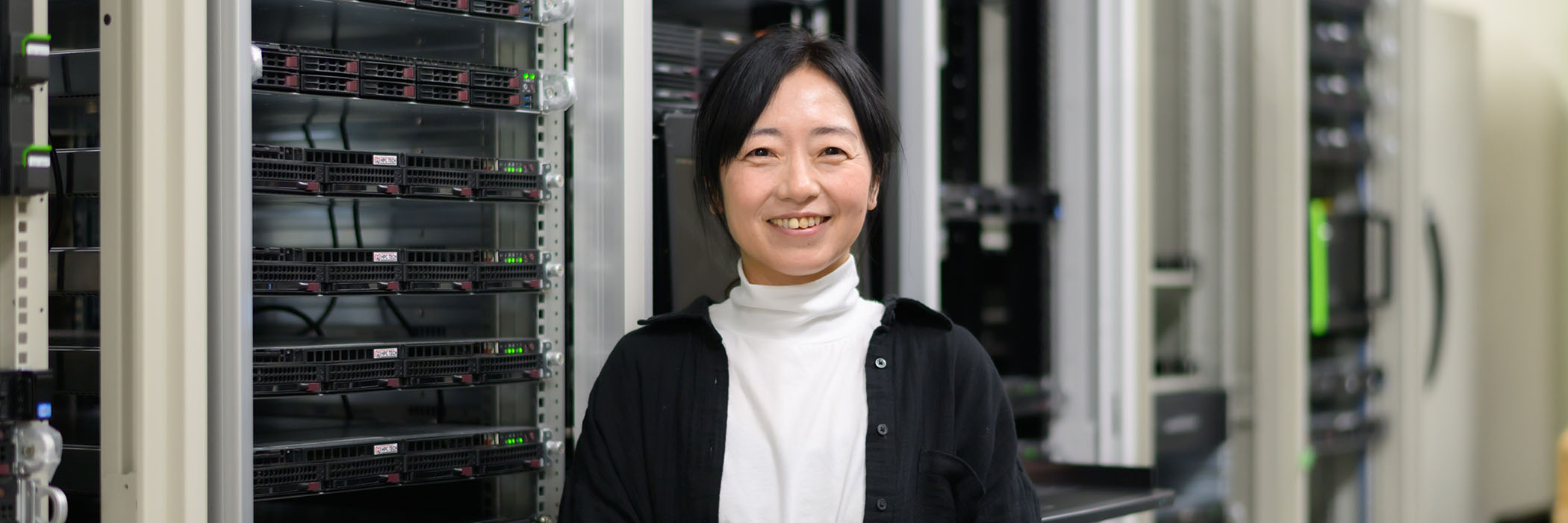
Every moment I find joy in fuels my motivation.
Astronomy Data Center, Senior Specialist
Junko Furusawa
Work, study, childbirth, and childcare. The words of my advisor and husband pushed me forward.
I originally studied to become a teacher, and previously worked as a part-time assistant at a university and as a junior high school teacher. I met my husband, who now works at the same Astronomy Data Center (ADC), when we were both university students. In the s pring of 2002, my husband was transferred to Subaru Telescope, so we got married and I moved to Hawai‘i with him. At the time, I had a visa that didn’t allow me to work, so I was accepted at Subaru Telescope as an unpaid special researcher. Later, after changing to a visa that permitted employment, I worked at RCUH (Research Corporation of the University of Hawai‘i) in computer maintenance . I also pursued doctoral studies at The Graduate University for Advanced Studies, SOKENDAI, from 2005 to 2009. However, just before enrollment, I discovered I was pregnant... Juggling work, studies, childbirth, and childcare. I considered giving up on entering SOKENDAI, but my advisor and husband encouraged me, saying, “Why not see how far you can go?” Thanks to their support, I earned my doctorate. Around that time, my husband was transferred back to Japan, so we returned as a family.

My work primarily involves analyzing imaging data and maintaining the computational machine environment.
My current duties at ADC can be broadly divided into two main tasks. The first is processing data captured by the Hyper Suprime-Cam (HSC) instrument on the Subaru Telescope , cataloging the data for scientific use, and loading them into databases so that they can be used for science. Without knowing a celestial object’s magnitude or precise position, the data is scientifically unusable, so I clean and refine it. Additionally, using both new and archived data, I study changes in luminosity and position through time-series differences to elucidate the processes of galaxy formation and evolution.
Another task is maintaining the computational machine environment. We’re tackling the challenge of how to speed up searches for the ever-growing, massive amounts of data. We need to build a file system that can handle and display petabytes of data at once, so it involves a lot of trial and error. Recently, I’ve been responsible for setting up RAID configurations and Lustre environments, as well as self-hosting open-source business chat tools for information sharing.
To make “FUREAI (Friendly) Astronomy” memorable for children.
The National Astronomical Observatory of Japan (NAOJ) runs “FUREAI (Friendly) Astronomy” (note 1), an educational outreach program for elementary and junior high school students nationwide, and I serve as an instructor every year. Questions like “Why do the stars appear in the same place the next day?” from elementary students are so innocent, and seeing their eyes sparkle with curiosity is truly wonderful. However, since we can’t observe actual celestial objects during the lecture, I aim to at least let them see the Moon with their own eyes that evening and night after hearing about it. I propose scheduling lectures around when the Moon is waxing to full-phase. Also, when astronomical events like lunar eclipses or planetary conjunctions occur, incorporating them into the lecture immediately captures the children’s natural curiosity . So, I try to include timely topics whenever possible. FUREAI Astronomy is different from regular classes for the students, so it has a real impact on elementary and junior high students, doesn’t it? Experiences like this during childhood tend to leave a lasting impression, so I always think about how to make FUREAI Astronomy memorable for them. I’m constantly studying how to convey it effectively.
- (note 1) “FUREAI (Friendly) Astronomy” is an educational program that NAOJ has offered since 2010, where professional astronomers visit elementary and junior high schools around Japan to deliver astronomy lectures.
When things aren’t going well, they sometimes appear in my dreams.
I’m interested in how distant galaxies have evolved... When I analyze massive amounts of data, catalog it, and plot it in 3D, the results become visually apparent. That moment makes me go, “Wow!” It’s thrilling. What was just numbers before suddenly appears in stereoscopic vision.
My current job allows me a fair amount of freedom to pursue my own interests. Like choosing which programming language to use, for example. Sometimes I realize midway, “Oh, I should’ve gone with that other language.” Figuring out how I’d do things efficiently—programming is creative and fun. But hitting a wall is tough, right? Whether it’s research or computational machines, when things aren’t working out, I might spend a week or so unable to sleep, not knowing what the problem is. It even shows up in my dreams (laugh).
Regarding the workplace environment, I want to keep making it better going forward. I want to value communication, mutual understanding, building trust among colleagues, and maintaining an environment and workstyle that everyone finds enjoyable.
Interview Date: July 31, 2025 / Published: January 29, 2026
Interview & Article: Masami Usuda / Translation: Hiroko Komiyama & Ramsey Lundock / Photo: Shogo Nagayama
The contents of this article are as of the interview date.