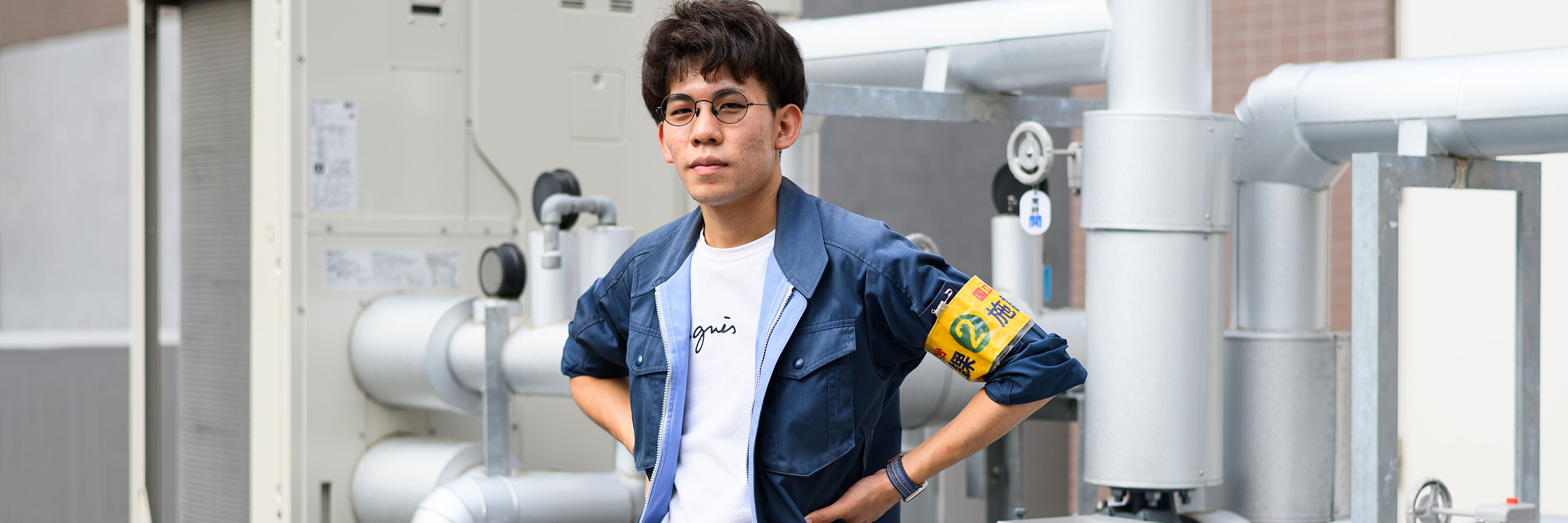
Things only those who once gave up on space can see, things only they can create.
Administration Department, Facilities Group, Maintenance Unit, Staff
Iori Kawahara
I find it easy to work because I’m given discretion.
The Facilities Group primarily handles maintenance and management of lifelines on campus; planning; construction; and repairs. On a day-to-day basis, this includes tasks like tree trimming and wasp nest removal. On a larger scale, we managed the renovation project for the 188-cm telescope at the Subaru Telescope Okayama Branch, which was completed in December 2024. While I’m primarily based at Mitaka Campus, my responsibilities also extend to managing the Nobeyama Radio Observatory, the Okayama Branch Office, Ishigakijima Astronomical Observatory, and the Subaru Telescope. This year (2025), I have a business trip scheduled to NAOJ Chile around October.
The Facilities Group has seven full-time members, but each has a different role; no one else handles the same work as I do. So, I often work independently. I’m given a fair amount of discretion, and this kind of work environment suits me very well. I think about what might be better or what should be avoided, or discuss with researchers to figure out the best approach... I can decide many things on my own.

Aerospace engineering, part-time job at a bookstore, two years in the job interview process.
My interest in stars began thanks to my mother’s influence, but I first properly observed them myself during the 2003 Mars opposition. I carried my telescope all the way to the michinoeki-doshi recreation area to see it. After that, I grew fond of space-themed movies and sci-fi, and started vaguely dreaming of going to space someday. Later, I entered the Aerospace Engineering course at a technical college, where I worked on structural design for satellites. My graduation research involved thermal structural analysis. I went to university in Muroran and chose the Aerospace Systems Engineering course . But university felt different compared to the technical college. At the technical college, most people were like, “I love this stuff so much I can’t help myself,” but at university, it felt like people were just sort of half-heartedly there to study... That’s partly why I dropped out and returned to Tokyo. I started working part-time at a bookstore for the time being. While working there, I learned that the National University Corporation was recruiting staff, so I applied. The first time was in 2020. I made it to the interview step, but didn’t get the job. After that, I kept working part-time at the bookstore while studying. I applied again in 2021, passed the first round of exams, and was wondering where to take the second round when the National Astronomical Observatory of Japan posted another opening. This time, I got the job and started on October 1.
Actively meet with people to fulfill user requests.
On my days off, I spend a lot of time riding my motorcycle. I also play video games, watch movies, and frequently tune in to live broadcasts of auto races. I play music too—violin, viola, and drums. I participate in an orchestra with old friends and we put on public performances a few times a year. I’m always on the move; I’ve been told, “It might kill you to stop moving.” (laugh).
My philosophy is to just try all sorts of things. After dropping out of university, I worked at a bookstore, and before that, I did customer service part-time jobs. I believe in cherishing the connections that come my way at each stage. In my current job, I focus on conversations and listening. I actively seek out people—like stopping to chat with people I pass in the hall —to learn things that I might otherwise miss. My constant approach is to first understand how they want to use the equipment, then comprehensively assess if it fits NAOJ’s environment and finally fulfill the researchers’ and users’ requests. That’s what I’m always doing, and I consciously strive to keep doing it.
To keep things fun and fresh, I’ll handle the infrastructure.
In 2024, the Subaru Telescope celebrated its 25th anniversary, and NAOJ marked 100 years since its relocation to Mitaka. While these are milestones, they are ultimately just waypoints. Just as stargazing remains a joy for people, I want the observatory to stay fun and fresh. To make that happen, I’ll build the infrastructure. Requests change with the times. So first, we need to understand how people want to use it, then determine what equipment we must install and what environment we must create. I want to maintain and change the environment while listening to those voices. I’m someone who once gave up on space. I think I see things differently from those who have walked this road without straying off the path. The observatory equipment designed by someone like me is probably, in a way, closer to space than what others might create.
My current workplace is incredibly enjoyable for me. I don’t mean to push myself, but I end up doing it anyways. I see my peers from technical college from time to time, and they’re all doing amazing things. Seeing that makes me think, I want to catch up to them. I can’t lose.
Interview Date: July 24, 2025 / Published: January 23, 2026
Interview & Article: Masami Usuda / Translation: Hiroko Komiyama & Ramsey Lundock / Photo: Shogo Nagayama
The contents of this article are as of the interview date.