
A Boy Who Loved Games Eventually Entered the World of Digital Imagery.
Center for Computational Astrophysics, Research Expert
Hirotaka Nakayama
I landed a job at the game development company I'd dreamed of working for since high school.
Originally, I had wanted to join a game company. When I was a child, I fixed up and used a game console I had found discarded as non-combustible garbage. That was my first game console (laughs). When I was in high school, Final Fantasy VII was released; I decided I wanted to join the company making that game. I even chose which university entrance exams to take based on that and ended up entering the Department of Information and Image Sciences. But simply graduating from university, I didn’t have anything to make me stand out during job hunting, or anything like a portfolio, so I continued to study in graduate school. From there, I landed my dream job at Square Enix Co., Ltd.
After joining, I worked as a designer for real-time CG. The work was fun. It ultimately connected to my current job, I’m glad I did it... but after about three years, I started having doubts about myself, endlessly creating things like barrels and trees for game backgrounds. I felt that I wanted to move to a more academic setting. I started to study at graduate school again while working. My professor at the time told me about an opening at the National Astronomical Observatory of Japan, so I changed jobs.
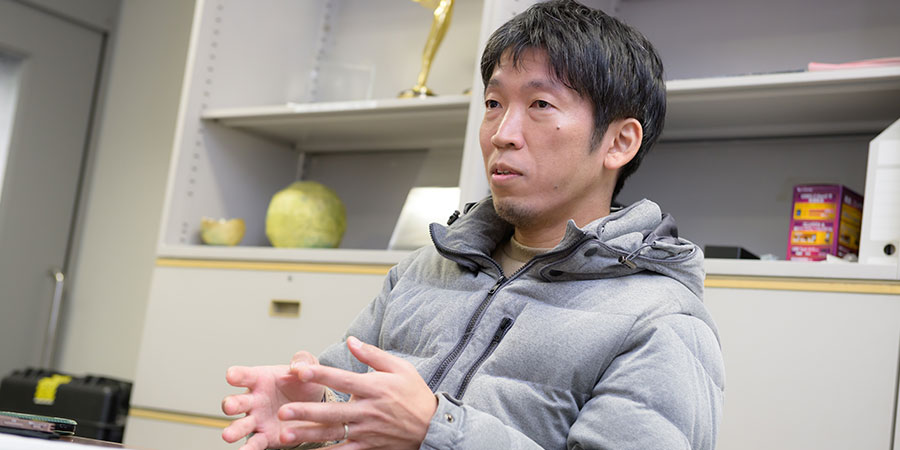
Transferred to 4D2U. Renovating the theater in 2015.
I joined NAOJ in 2008, originally as part of the Science Culture Promotion Unit (note 1). It was a limited-time project to cultivate personnel for the visualization of observational data about the Universe, but when I applied, I didn't really understand the job details. Once I started the job, it was incredibly tough. On the teaching side, it was an organization role, or an assistant role, but I ended up taking over one of the classes partway through. During the graduation project, I stayed overnight at the observatory to work on it. That was the first year. The next year, I transferred to my current position in 4D2U (4-Dimentional Digital Universe Project).
I am very much at home with the 4D2U mood, and I can concentrate on creating visuals. I think, “This suits me better” (laughs). My main job is creating visualization movies based on astronomical simulation data calculated by researchers. I produce images and videos for press releases, as well as videos used in science museums, schools, and entertainment venues. In 2015, the 4D2U Dome Theater was renovated, and I was involved in aspects like increasing the resolution and changing the stereoscopic viewing method.
(note 1) This refers to the “Science Culture Promotion Unit through Astronomy Image,” which was selected for funding under the adoption of adjusting cost for the promotion of science and technology “Realization of Regional Revitalization through Bases for Human Resource Creation” from the Ministry of Education, Culture, Sports, Science and Technology's Science and Technology Promotion Adjustment Fund starting from Fiscal Year 2007. The unit continued activity until 2011 at NAOJ, with the goal of cultivating human resources by leveraging next generation videos by using 4-Dimensional cosmic video and Subaru Telescope images etc. as research materials in other research fields and video culture.
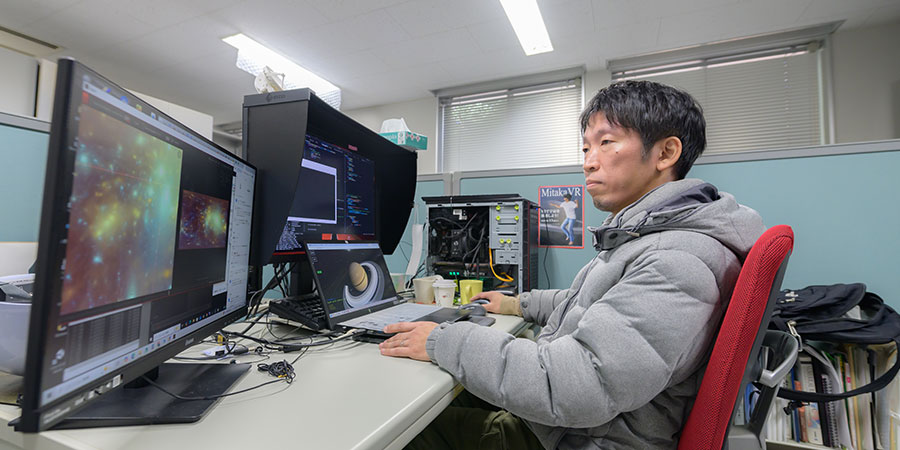
Experience the thrill of leveling up! The fun of continuous learning.
When I first joined, we could only produce flat images or Dome Master format images using 4D2U. After that, I proposed a VR version, and it was decided to produce it as part of 4D2U. I have created several VR movies, but among them “A Journey Through the Milky Way” won the Grand Prix for the VR Category of the Lumiere Japan Awards 2017, promoted by the Advanced Imaging Society (note 2) and the Best VR Science Experience at the Lumiere Awards, promoted by the US Headquarters of the Advanced Imaging Society (note 3).
The difficult part of this job is that there is too much data. You can have hard-disks upon hard-disks, and it still isn’t enough. You have to start from creating the data processing environment yourself. It is also hard because you have to turn the data into a stereoscopic dome version. But where there are no examples to follow and you have to try to think for yourself, that “I did it!” moment feels great. When, considering the process, I create a rendering tool myself, I feel like one of my skills has leveled up. I will continue perpetually learning from here, that in itself makes it interesting to me.
(note 2) 4D2U movie Wins Lumiere Japan Awards 2017 Grand Prix (December 26, 2017)
(note 3) 4D2U Movie Wins “Best VR Science Experience” at the 2018 Lumiere Awards (March 22, 2018)
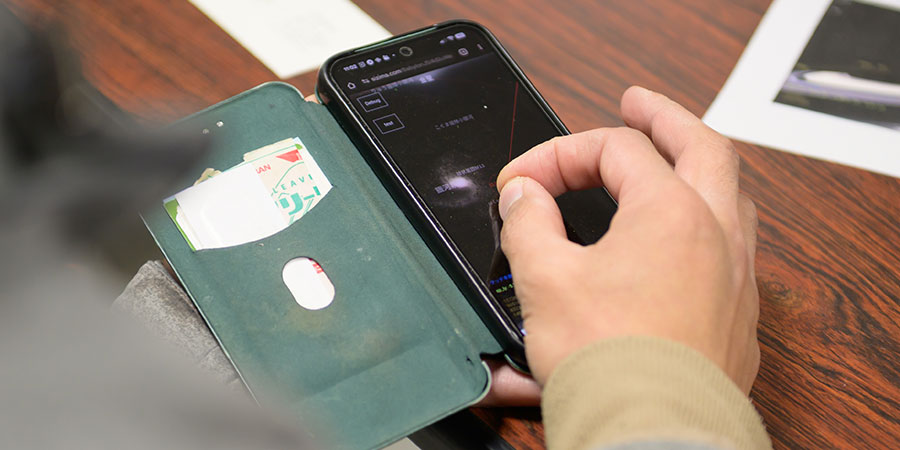
Add “fun.” I want kids to use it enthusiastically.
This project might be difficult for a “wait for instructions” type of person. About a year ago, I was told to “think about what to do next.” Currently, I’m creating a web application version of the Four-Dimensional Universe Viewer, Mitaka (note 4). Up until now, the download version could only be used on Windows. By changing that to a web app, it can be used on various devices, such as cellphones, regardless of the operating system. I have a 7-year-old and a 3-year-old child at home. Right now, in elementary schools the GIGA School Program is moving forward, to increase PCs to one-per-student. I started work because I want to Mitaka usable on those computers. Once it has advanced to a certain level, next I think I’ll make a terrestrial mode, so that after landing on Earth, you can walk around Mitaka Campus. Kids probably won’t use it unless it’s fun, so you’ll be able to do things like click on a building to see the interior. Also, I’ll add a link so that when you click on the 4D2U Dome Theater, you’ll be able to watch videos posted on YouTube. Going forward, I want to create various ways for many people to enjoy these contents.
Interview Date: January 16, 2026 / Published: April 27, 2026
Interview & Article: Masami Usuda / Translation: Ramsey Lundock / Photo: Shogo Nagayama
The contents of this article are as of the interview date.