- Science
Jupiter's Moons Remain Slightly Illuminated, Even in Eclipse
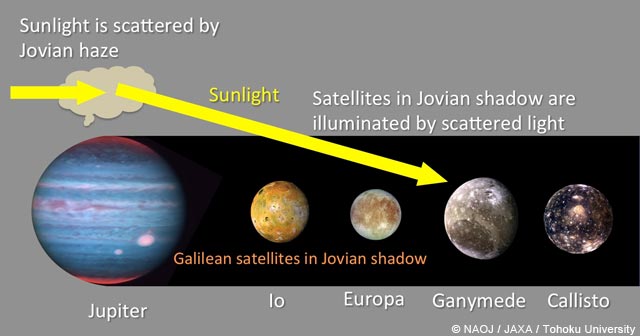
Astronomers using the Subaru Telescope and Hubble Space Telescope have found that Jupiter’s Galilean satellites (Io, Europa, Ganymede, and Callisto) remain slightly bright (up to one millionth of their normal state) even when in the Jovian shadow and not directly illuminated by the Sun. The effect is particularly pronounced for Ganymede and Callisto. The finding was made by researchers at Tohoku University, Institute of Space and Astronautical Science/Japan Aerospace Exploration Agency (ISAS/JAXA), National Astronomical Observatory of Japan (NAOJ), and elsewhere.
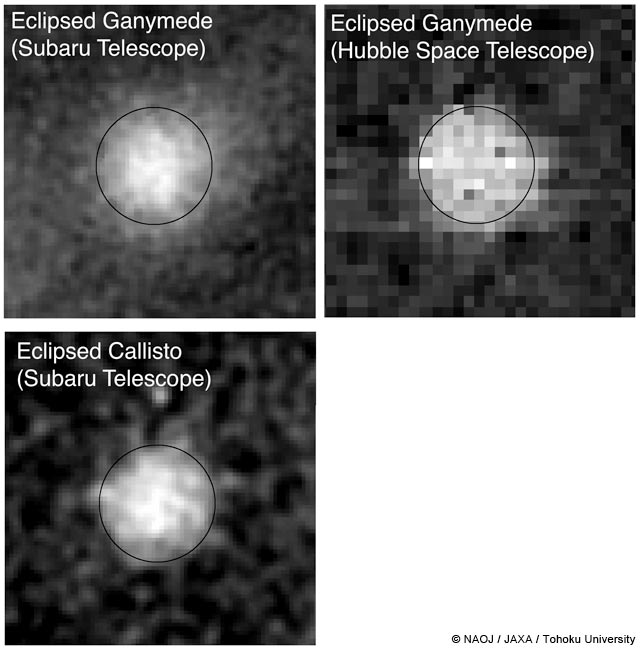
Although Jupiter is a familiar planet, there are many unresolved issues about its atmosphere. One example is the origin of the cloud particles composing Jupiter’s banded appearance. The cloud particles are assumed to grow from tiny particles called aerosols or hazes. Researchers expect that those hazes form somewhere in the upper part of Jupiter’s atmosphere, which is very difficult to observe. The unexpected discovery of haze-induced brightening of the Galileans provides a new way to study the mysterious part of Jupiter’s atmosphere. In addition, since astronomers usually observe the planets in our solar system by reflected sunlight, one of the unique aspects of these new observations at Jupiter is that observers can precisely measure the transmitted sunlight through the planetary atmosphere.
The scientific paper on which this article is based will appear in the Astrophysical Journal in July 10, 2014. (Tsumura et al. 2014, “Near-infrared Brightness of the Galilean Satellites Eclipsed in Jovian Shadow: A New Technique to investigate Jovian Upper Atmosphere”)