- Science
Simulations Explain Baby Carriage Wheels Around Baby Stars
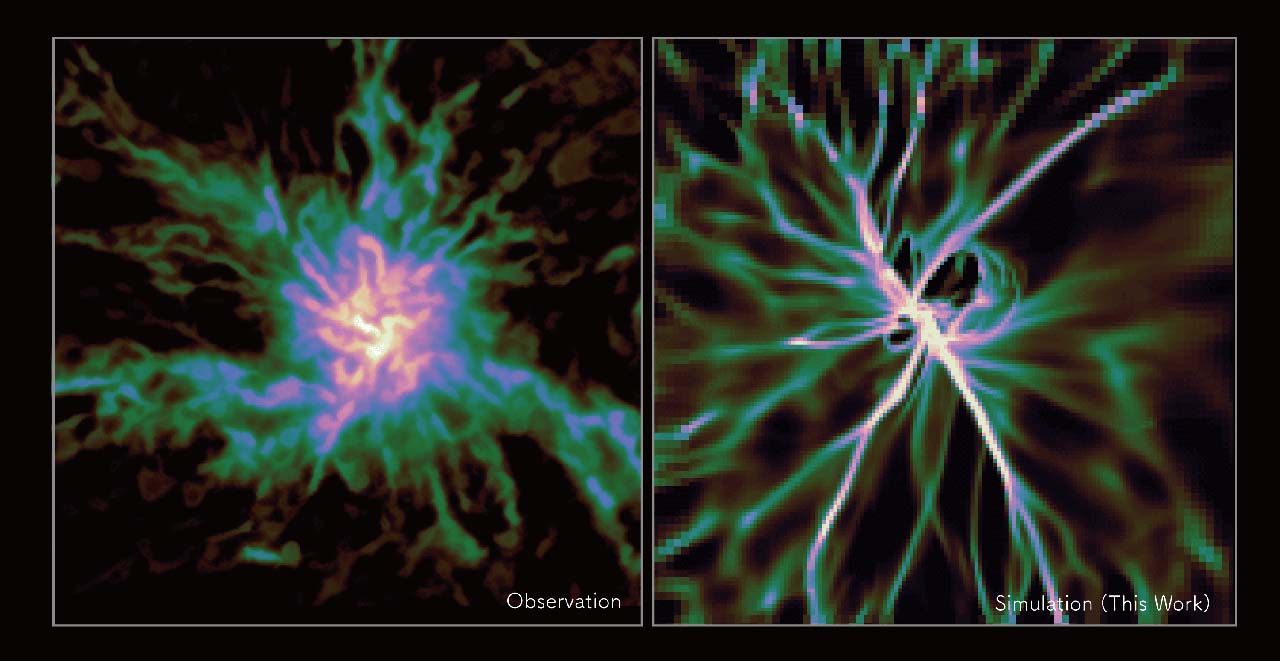
Research using multiple supercomputers, including ATERUI III at the National Astronomical Observatory of Japan, has found a possible explanation for the hub-and-spoke pattern seen in some molecular clouds where baby stars are forming. According to the new numerical simulations, if an external shock interacts with magnetic fields which have been warped by the motion of the clouds, gas can be channeled into a shape resembling the spokes on the wheels of a baby carriage.
When parts of molecular clouds become dense enough, they can collapse under self-gravity. As a result of this collapse, the gas in the clouds condenses into protostars which will grow into stars. For this reason, molecular clouds are nicknamed “stellar cradles.” But some of these sites of star formation are more like baby carriages than cradles because they have filaments of gas extending toward a central hub, forming a shape like a spoked wheel.
Researchers from Kyushu University and Nagoya University investigated the possibility that magnetic fields within the clouds might play a role in forming this distinct shape. Using ATERUI III, a dedicated-astronomy supercomputer operated by the National Astronomical Observatory of Japan, they modeled how gas and magnetic fields evolve together over time. The results show that as the cloud collapses under self-gravity, it pulls the magnetic field lines inward, bending them into an hourglass shape. The team then simulated the effects of a disturbance like a shock wave from a nearby supernova remnant or from expanding gas around a massive star. The team found that if this shock hits the curved magnetic field at certain angles, it strengthens parts of the magnetic field, forming invisible channels that guide compressed gas into long, narrow filaments converging toward the center.
The team now plans to conduct more simulations to test whether this mechanism can explain more asymmetric and complex shapes. This will help clarify how the diversity of observed hub-filament systems reflects differences in cloud environments and how such environments shape the formation of massive stars and clusters.
Detailed Article(s)
Simulations Explain Baby Carriage Wheels Around Baby Stars
Center for Computational Astrophysics
Release Information
Researcher(s) Involved in this Release
- Shingo Nozaki (Kyushu University)
- Shu-ichiro Inutsuka (Nagoya University)
Coordinated Release Organization(s)
- Kyushu University
- Nagoya University
- National Astronomical Observatory of Japan, NINS
Paper(s)
- Shingo Nozaki and Shu-ichiro Inutsuka “An Origin of Radially Aligned Filaments in Hub-filament Systems”, in Astrophysical Journal Letters, DOI: 10.3847/2041-8213/ae4c84