- Science
Astronomers Find Most Chemically Primitive Galaxy in Early Universe
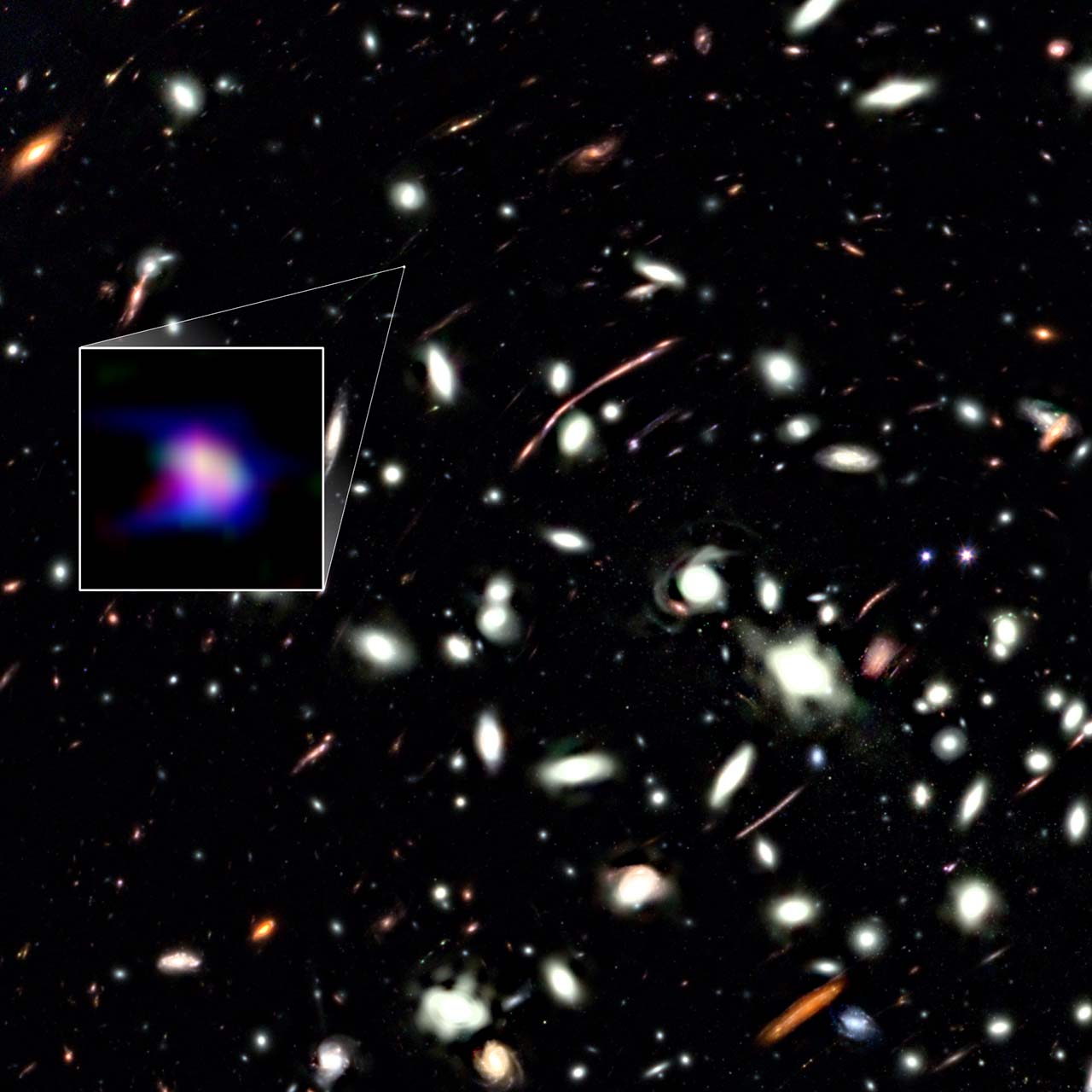
An international team of astronomers has used the James Webb Space Telescope (JWST) and a natural phenomenon known as gravitational lensing to achieve a definitive characterization of LAP1-B, an ultra-faint galaxy from 13 billion years ago. Expanding upon initial detections, this new study revealed a record-breaking low oxygen abundance – merely 1/240th that of the Sun. This chemically primitive state, coupled with an elevated carbon-to-oxygen ratio and a dominant dark matter halo, suggests that LAP1-B is the long-sought “ancestor” of the mysterious fossil galaxies found near our Milky Way Galaxy today.
Just after the Big Bang, contained only light elements like hydrogen and helium. The heavier elements, such as oxygen and carbon, were forged much later inside the hearts of the very first stars. For decades, astronomers have tried to find the moment these “first-generation stars” began scattering heavier elements across the cosmos. However, the earliest galaxies hosting such young, primordial stars are so small and faint that seeing their chemical makeup was considered nearly impossible – until now.
A research team led by Kimihiko Nakajima of Kanazawa University and including Masami Ouchi at the National Astronomical Observatory of Japan (NAOJ) and the University of Tokyo focused on a tiny, ultra-faint galaxy named LAP1-B. Its light was magnified 100 times by a phenomenon called “gravitational lensing,” where the gravity of a massive galaxy cluster acts like a natural giant telescope lens in space. By staring at this spot for over 30 hours with JWST, the team determined that the galaxy’s oxygen abundance is roughly 1/240th that of the Sun. “I was instantly thrilled by the extreme lack of oxygen,” says Nakajima. “Finding a galaxy in such a primitive state is astonishing. It’s a chemical signature that clearly indicates a primordial galaxy caught in the moments shortly after its formation.”
Beyond its primitive nature, the galaxy exhibited a high carbon-to-oxygen abundance ratio. This unique ratio of elements aligns closely with theoretical predictions for the material dispersed by the explosions of the universe’s first-generation stars.
The team also discovered that LAP1-B is incredibly lightweight – less than 3,300 times the mass of the Sun – implying that most of the galaxy consists of invisible dark matter. This feature, together with its unique chemical makeup, makes it a near-perfect match for the “Ultra-Faint Dwarf galaxies (UFDs)” found near our Milky Way Galaxy today, which are extremely dim, small, and contain very few stars.
“UFDs are not only the faintest galaxies; they are composed of ancient stars over 12 billion years old and are often described as ‘fossils of the Universe,’” explains Ouchi. “Astronomers suspected they might be the remains of the Universe’s earliest galaxies because they lack heavy elements, but astronomers never had a direct link – until we found LAP1-B.”
Ouchi continues: “It is a profound surprise to find that LAP1-B looks exactly like the ‘ancestor’ we had only imagined in theories. This helps us solve the mystery of why these cosmic fossils have survived in their current form to the present day.”
This discovery establishes a new way to map the birth of elements and the formation of the Universe’s oldest structures. Moving forward, the team will use JWST to search for even more primitive objects, aiming to find the very first galaxies ever formed.
Detailed Article(s)
The Most Chemically Primitive Galaxy in the Early Universe: Clues to the Mysterious Origins of Ultra-Faint Dwarfs
Kanazawa University
Release Information
Researcher(s) Involved in this Release
- Kimihiko Nakajima (Kanazawa University)
- Masami Ouchi (National Astronomical Observatory of Japan / University of Tokyo)
Coordinated Release Organization(s)
- Kanazawa University
- National Astronomical Observatory of Japan, NINS
- Institute for Cosmic Ray Research, The University of Tokyo
Paper(s)
- K. Nakajima et al. “An ultra-faint, chemically primitive galaxy forming in the reionization era”, in Nature, DOI: 10.1038/s41586-026-10374-1