- Science
How Jupiter Cultivated More Large Moons than Saturn — A magnetospheric cavity explains the difference
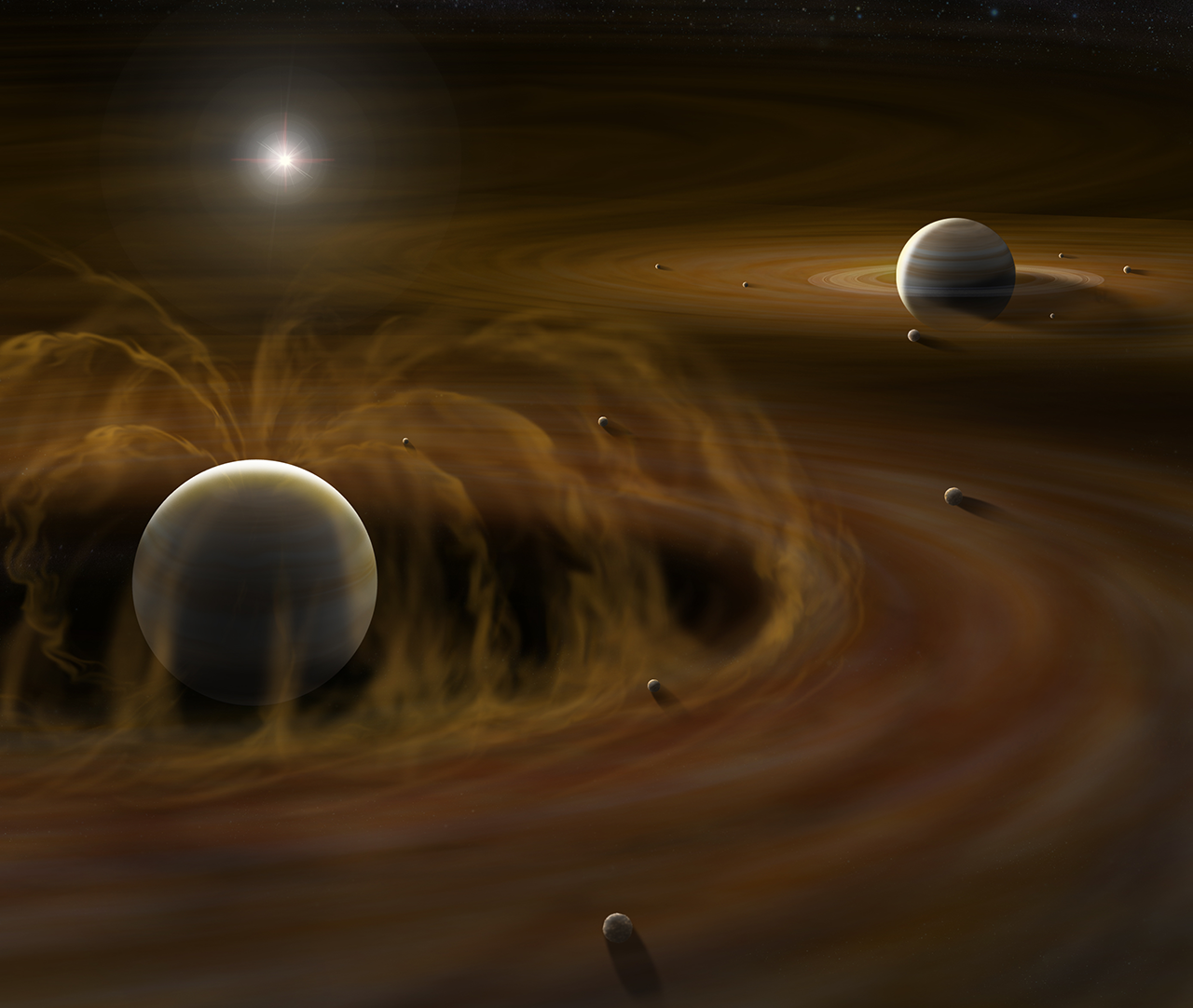
The Solar System’s two largest gas giant planets, Jupiter and Saturn, have extensive but very different families of moons orbiting them. New simulations conducted on the PC cluster at the Center for Computational Astrophysics (CfCA), National Astronomical Observatory of Japan (NAOJ) showed that the planet’s magnetic field plays a role in creating an environment where the new moons can survive and grow, thus shaping the evolution of the system.
Jupiter has more than 100 reported moons, including four large ones (Ganymede, Callisto, Io, and Europa). Saturn has more than 280 reported moons, but only one large one (Titan). So it is a puzzle why Saturn managed to cultivate more moons, but fewer large moons than Jupiter.
A team led by Kyoto University, including researchers from institutes in Japan and China, used the PC cluster at CfCA, NAOJ, to simulate the formation of the moon systems around Jupiter and Saturn. This simulation recreated the planets’ internal structure to calculate the thermal evolution of Jupiter and Saturn and how their magnetic fields have varied over time.
Moons form from material in a “circumplanetary disk” of gas and dust orbiting the young planet. The disk nurtures the young moons, but interactions with the disk may cause them to fall into the planet. The simulations showed that young Jupiter generated a strong planetary magnetic field that created a safe “cavity” around the planet where its young large moons were prevented from migrating too close to their host planet. Young Saturn lacked a strong magnetic field, so only one large moon managed to survive.
“Testing planet formation theory is somewhat difficult because we have only our Solar System for reference, but there are multiple satellite systems close to us whose detailed characteristics we can observe,” says Yuri I. Fujii, primary author of the report announcing these findings. Next, the team is interested in expanding their theory to other moons and potential exomoon systems.
Detailed Article(s)
How Jupiter Cultivated More Large Moons than Saturn —— A magnetospheric cavity explains the difference
Center for Computational Astrophysics
Release Information
Researcher(s) Involved in this Release
- Yuri Fujii (Graduate School of Human and Environmental Studies, Kyoto University)
- Masahiro Ogihara (Tsung-Dao Lee Institute, Shanghai Jiao Tong University)
- Yasunori Hori (Okayama University)
Coordinated Release Organization(s)
- Kyoto University
- Okayama University
- National Astronomical Observatory of Japan, NINS
Paper(s)
- Fujii et al. “Different architecture of Jupiter and Saturn satellite systems from magnetospheric cavity formation” in Nature Astronomy, DOI: 10.1038/s41550-026-02820-x