
What is ATERUI III?
The dedicated astronomy supercomputer ATERUI III started full-scale operation in December 2024. It has a theoretical computational performance of 1.99 Pflops and consists of two systems with different characteristics: System M, which prioritizes memory bandwidth, and System P, which prioritizes memory capacity. Utilizing the characteristics of each system, ATERUI III solves a variety of problems in astronomy through simulations.
Astronomy had historically developed with the two pillars of “observational astronomy,” which observes and describes the actual Universe, and “theoretical astronomy,” which describes the Universe’s appearance based on physics and mathematics. Recently, a new type of astronomy called “simulation astronomy” which uses computers has emerged. Using the computing power of supercomputers, we are now able to numerically solve equations that cannot be solved based on theory alone. ATERUI III aims to depict a more realistic Universe through simulations utilizing its great calculation speed.
Specifications
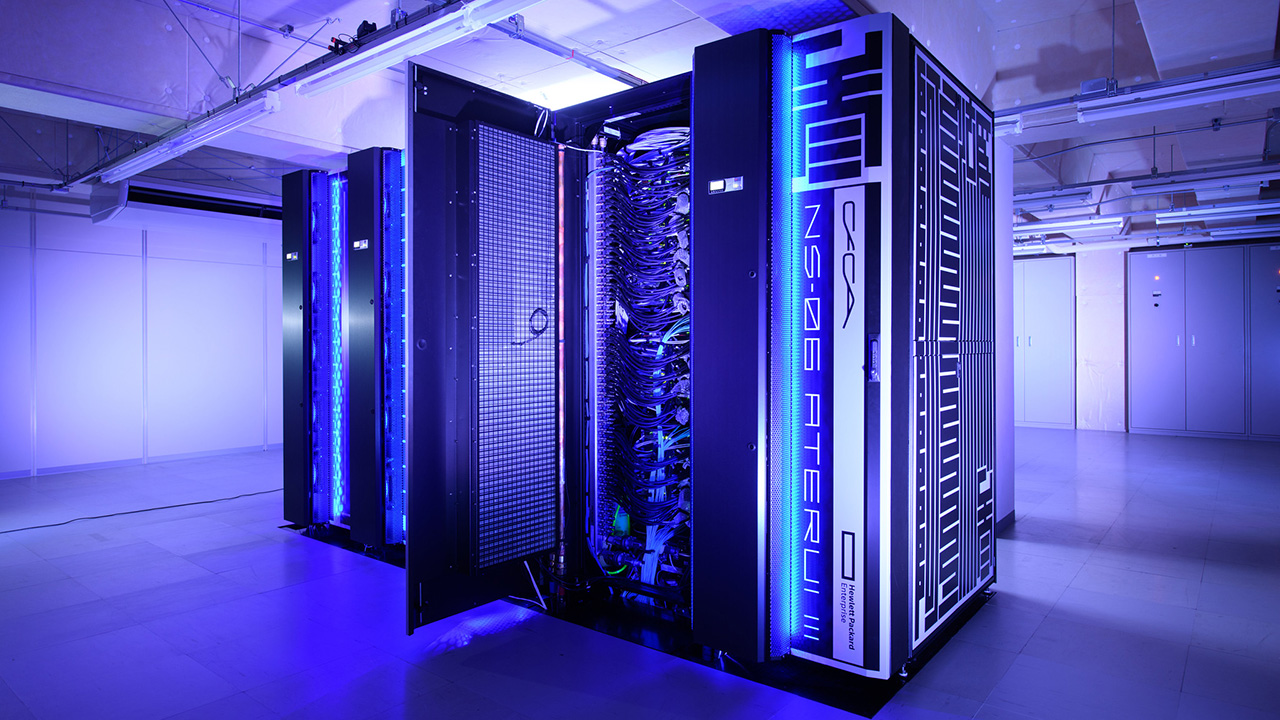
| Location | Mizusawa Campus (Hoshigaoka, Mizusawa, Oshu, Iwate, Japan) | ||
|---|---|---|---|
| Prime manufacturer | Hewlett Packard Japan, G.K | ||
| Basic Specifications | |||
| Model | HPE Cray XD2000 | ||
| ATERUI III (Total System) | ATERUI III (System M) | ATERUI III (System P) | |
| Theoretical peak performance | 1.99 Pflops | 1.4 Pflops (6.8 Tflops) | 0.57 Pflops (7.168 Tflops) |
| CPU | Intel® Xeon® CPU Max 9480 | Intel® Xeon® Platinum 8480+ | |
| Number of Cores | 32,256 | 23,296 (112) | 8,960 (112) |
| Number of Nodes | 288 | 208 | 80 |
| Memory Bandwidth | 665 TB/s (3200 GB/s) | 98.24 TB/s (614 GB/s) | |
| Memory Capacity | 26.6 TB (128 GB) | 40.96 TB (512 GB) | |
The numbers in parenthesis are the specifications for 1 node.
History
| December 2024 | ATERUI III operation began |
|---|
CfCA Website
Explore the latest news and project updates on the official website. Japanese only.
