- Science
Local Environment Shapes Galaxy Growth in Early Universe
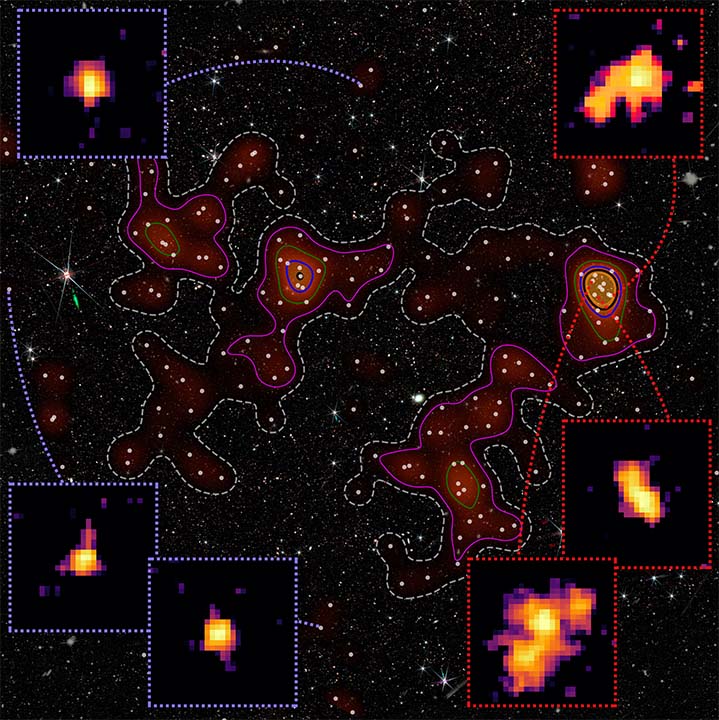
Astronomers using the James Webb Space Telescope observed a large group of galaxies which had been discovered in the early Universe by the Subaru Telescope. The observations show that even as early as 1.2 billion years after the birth of the Universe, the local environment was already influencing galaxy growth. These results provide new insights into the development of galaxies throughout the history of the Universe.
Galaxies are not evenly distributed in the modern Universe. Some galaxies are crowded together in structures known as clusters, and other galaxies are diffused over more sparse environments. Galaxies in modern clusters look very different from isolated galaxies. Galaxies in clusters tend to be larger, redder, and have more rounded shapes. A key question is when did these differences start to manifest.
To answer this question, an international research team including astronomers at the National Astronomical Observatory of Japan (NAOJ) used the James Webb Space Telescope (JWST) to observe the Loktak Protocluster, which existed when the Universe was only 1.2 billion years old. Located in the direction of the constellation Sextans, the Loktak Protocluster had been discovered by the same team using the Subaru Telescope, and takes its name from Loktak Lake in Manipur, India. The name reflects the way four separate galaxy concentrations are linked together into one larger structure, resembling the floating biomass islands of the lake. Galaxy protoclusters found in the early Universe are not as large as galaxy clusters in the modern Universe, but are believed to grow into clusters over the history of the Universe.
The team found that already at this early stage, galaxies in the Loktak Protocluster differed significantly from galaxies located in sparser regions. Although there was no difference when observed in ultraviolet light, which shows newly formed stars; when observed in optical light, which shows previously formed mature stars, galaxies in the protocluster were on average 1.4 times larger than galaxies in normal density environments. This implies that although the star-forming cores at the centers of the galaxies looked similar, galaxies in clusters had built up their outer structures of stars earlier and more rapidly.
These results show that the differences between galaxies in clusters and galaxies outside of clusters begin before the clusters are even fully formed. Follow-up observations with the Subaru Telescope and JWST will help determine whether this kind of environmental effect was common in the early Universe or unique to the Loktak Protocluster.
Detailed Article(s)
Just 1.2 Billion Years After the Big Bang, Galaxies Were Already Shaped by Where They Lived
Subaru Telescope
Release Information
Researcher(s) Involved in this Release
- Ronaldo Laishram (National Astronomical Observatory of Japan)
- Yusei Koyama (National Astronomical Observatory of Japan)
- Haruka Kusakabe (The University of Tokyo)
Coordinated Release Organization(s)
- National Astronomical Observatory of Japan, NINS
- Graduate School of Arts and Sciences, The University of Tokyo
Paper(s)
- Laishram et al. “Discovery of a z ≃ 4.9 Lyα Emitter Protocluster: Wavelength-dependent Environmental Effects on Galaxy Structure”, in The Astrophysical Journal Letters, DOI: 10.3847/2041-8213/ae5824